
Fast, Reliable Spray Foam Insulation Across Newport Beach
If you’re looking for spray foam insulation in Newport Beach, here’s the short version: we install both open-cell and closed-cell foam from Icynene and Demilec, we stock everything locally, and we can usually reach most Newport Beach homes within a day or two of your call. More importantly, we understand what coastal air does to insulation. Salt and persistent marine moisture change the calculation entirely, and a foam choice that works fine inland can create a mold problem a few blocks from the water. We plan for that from the first site visit. Call us at (855) 773-6429 to schedule a free estimate.
Placentia Insulation is a dedicated insulation contractor, not a generalist. Every crew member, every tool, and every conversation we have centers on one trade. For Newport Beach homeowners, that focus matters because coastal retrofits are detail work. The margin between a sealed, dry assembly and a moisture trap is often a matter of material specification and surface preparation.
Why Placentia Insulation Is Newport Beach’s Preferred Spray Foam Insulation Company
Homeowners across Newport Beach call us because we carry eight insulation brands and we actually match the material to the job. Most insulation contractors carry one or two product lines. We carry eight, including Reflectix service in Newport Beach, so your home gets what it needs, not whatever happens to be on the truck that morning. On a Balboa Island cottage with uninsulated walls and salt-laden air, we’ll spec closed-cell Demilec foam for its moisture-sealing properties. On a newer Newport Coast custom build, we may recommend something else entirely. The point is that the application drives the chemistry.
Alan Whitcomb leads our crew with a simple rule: inspect first, specify second, install third. That sequence matters in Newport Beach, where attic and crawl space conditions vary wildly from neighborhood to neighborhood. A 1960s Eastbluff ranch home has different venting, different framing, and different humidity patterns than a 1920s Cannery Village cottage. We treat each one as a separate problem to solve.
We answer the phone, we show up when we say we will, and our estimates are free. That’s the baseline. What sets us apart in Newport Beach is the product fluency: Icynene open-cell for tight, hard-to-reach cavities, Demilec closed-cell for rim joists and crawl spaces exposed to vapor drive, and Rockwool mineral wool where sound or fire resistance is the priority. It’s not a generic pitch. It’s a materials catalog, applied deliberately.
Crawl Space Spray Foam Insulation in Newport Beach
Crawl Space Spray Foam Insulation is one of the most common jobs we do in Newport Beach, and it’s also one of the most misunderstood. Inland, crawl space insulation is mostly about keeping floors warm. Here, it’s about keeping moisture out. The marine layer pushes damp, salty air into vented crawl spaces for most of the year. That air condenses on cool surfaces, wets insulation, and feeds musty odors that drift up into living space. Closed-cell spray foam applied to rim joists and band joists seals that pathway, stopping the moisture before it can enter.
A typical crawl space encapsulation with closed-cell spray foam in Newport Beach runs $2,800 to $6,200, depending on square footage, access, and whether we need to clean and prepare salt-exposed surfaces first. That preparation step is not optional here. Galvanized hangers and fasteners near the coast develop surface rust surprisingly fast, and spraying foam over unprotected rust just locks the problem behind a new layer.
Rim Joist Sealing Against Marine Air
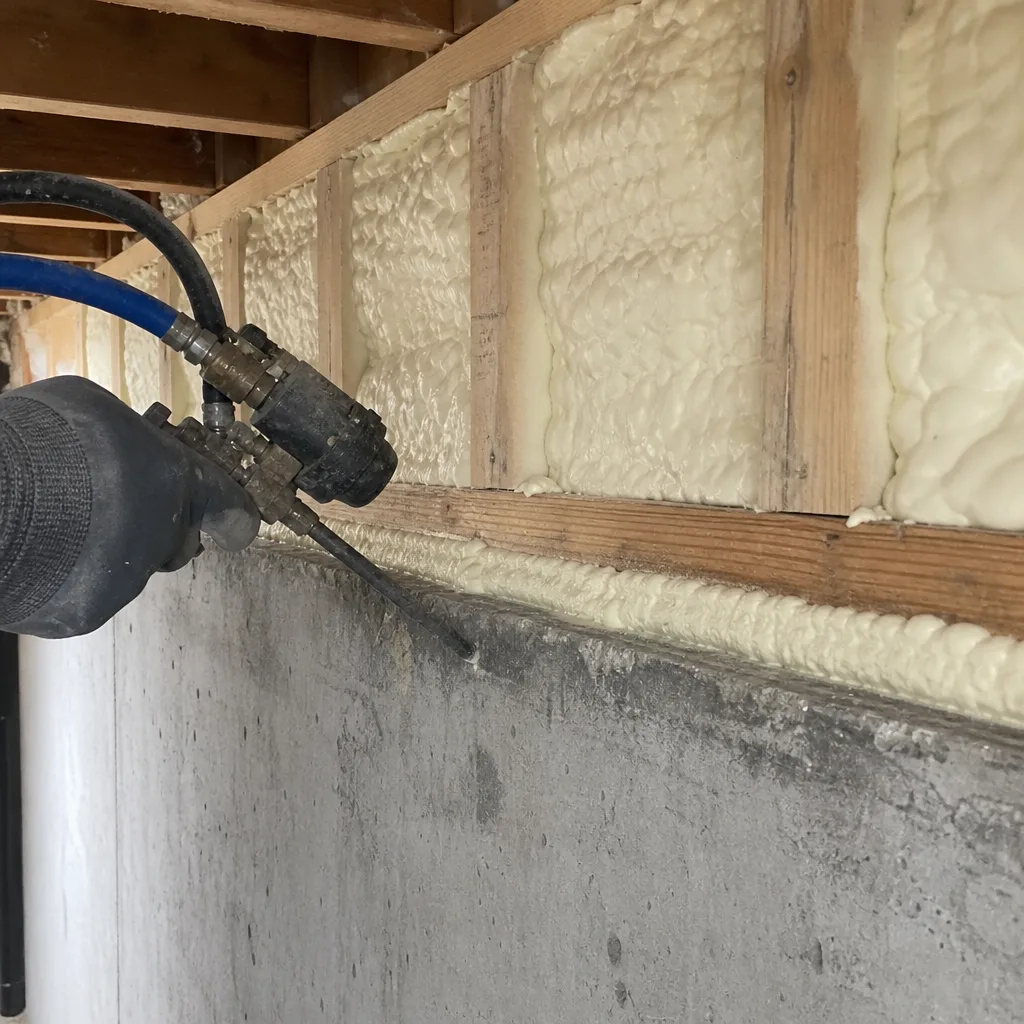
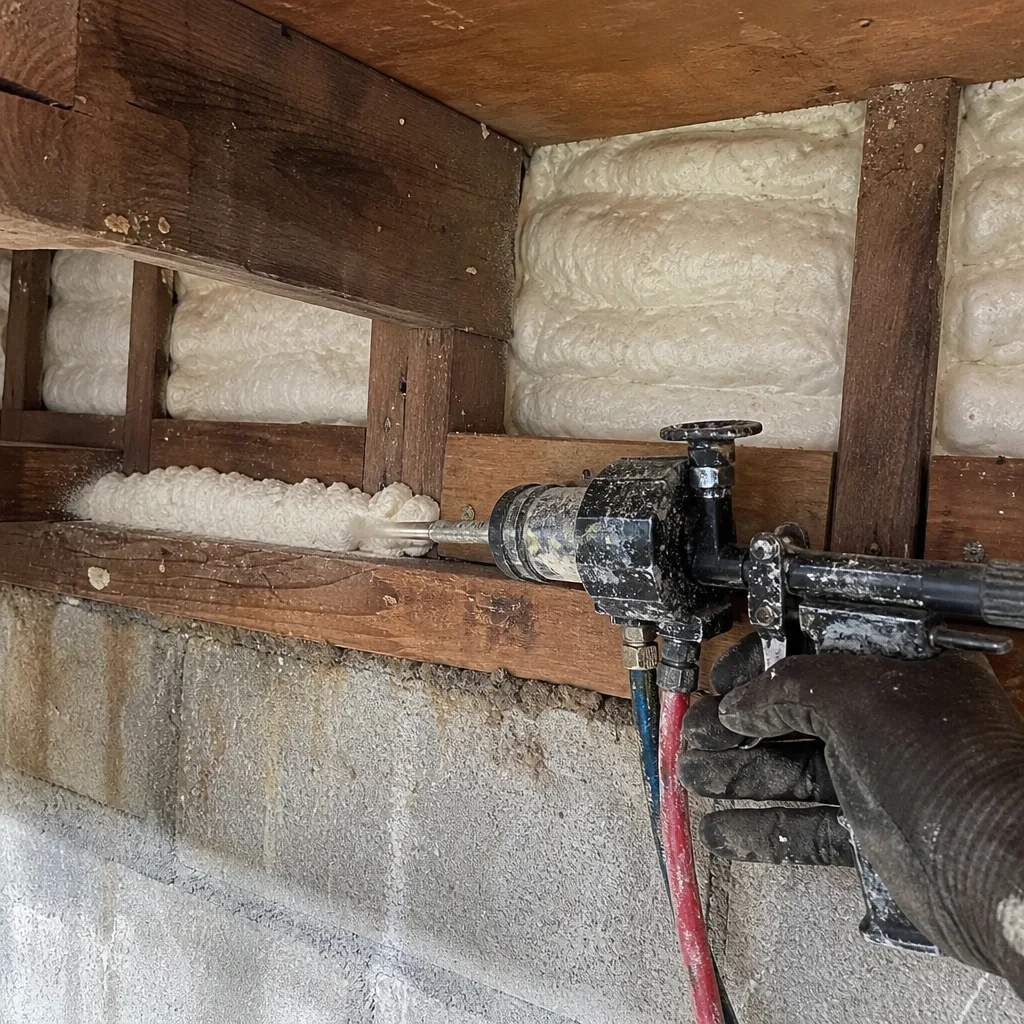
The rim joist is the horizontal board running around the perimeter of your floor framing. In a Newport Beach crawl space, it’s the primary entry point for salty air. We clean the surface, check for fastener corrosion, and apply two inches of closed-cell foam from the top of the sill plate to the subfloor. That seals the band and creates a continuous air barrier.
Moisture-Resistant Closed-Cell Work
Closed-cell foam is vapor-impermeable at two inches, which is exactly why we like it for Newport Beach crawl spaces. It blocks the moisture, and it doesn’t absorb water if there’s a plumbing drip or seasonal humidity spike. Open-cell foam has its place in walls and cathedral ceilings, but a damp crawl space calls for the closed-cell product, full stop.
Garage Spray Foam Insulation in Newport Beach
Garage Spray Foam Insulation in Newport Beach is often overlooked until the owner realizes what the garage is actually doing to the rest of the house. Bedrooms directly above garages stay cold in the winter because heat escapes through the uninsulated garage ceiling. And attached garages leak air into living space through every plumbing chase and electrical penetration in the shared wall. Spray foam, applied to the garage ceiling and shared walls, fixes both problems in a single pass.
For a standard two-car garage in Newport Beach, spraying the ceiling and a shared wall with closed-cell foam typically runs $1,900 to $4,100. If we’re also treating the garage’s band joist and any cantilevered bays, expect the higher end. And if the garage has a room above it that’s always too hot or too cold, the foam pays back through the noise reduction alone, never mind the utility bill.
Sealing the Garage Ceiling Plane
Fibrous insulation in a garage ceiling slows heat transfer, but it doesn’t stop air movement. Spray foam does both. We seal around electrical boxes, recessed light housings, and duct penetrations before spraying, so the finished plane is a true air barrier, not just a thermal layer.
The Shared Wall Detail
In Newport Beach homes built between the 1950s and 1980s, the wall between the garage and the house rarely has any insulation when we open it up. Spraying foam into those stud bays and sealing the band joist above cuts the air exchange that pulls car exhaust smell, humidity, and temperature swings into the house. It’s one of the highest-comfort-per-dollar improvements we do.
Trusted Brands We Service in Newport Beach
We stock and install Spray Foam Insulation products from Icynene and Demilec, two names that dominate the closed-cell and open-cell categories for good reason. For jobs where foam isn’t the right answer, which does happen in some Newport Beach wall assemblies, we keep GreenFiber cellulose and Rockwool mineral wool in active inventory. That breadth is unusual. It means we don’t force foam into a application where a different material would perform better, and it means turnaround on Newport Beach jobs is fast because we aren’t waiting on a distributor to ship a brand we don’t carry. We hold stock, and our crews know how each product behaves in coastal humidity.
Common Spray Foam Insulation Problems We See in Newport Beach Homes
- Corroded foil facers on older batt insulation. Fiberglass batts with foil or kraft paper facers start to delaminate within a season or two near the ocean. The facing peels, the insulation sags, and the thermal performance disappears. When that happens behind drywall, the only reliable fix is removal and replacement with spray foam.
- Moisture-trapping in unvented attic spaces. Older Balboa Island and peninsula cottages often have attic spaces that were never properly vented. If foam is applied without accounting for that, condensation forms inside the assembly. We always check venting before specifying open-cell versus closed-cell, and we document the existing conditions before we spray.
- Rusted fasteners and joist hangers compromising the seal. Spray foam adheres to the surface it’s applied to. If that surface is rusted, the adhesion fails. In salt-exposed crawl spaces and garages, we wire-brush surface rust and treat the metal before spraying, so the foam bonds to clean substrate and the seal actually lasts.
- Uninsulated rim joists pulling in damp marine air. In almost every Newport Beach crawl space we open, the rim joist is bare. That’s a direct conduit for humid coastal air. Sealing it with closed-cell foam is the highest-leverage foam application in a coastal home, full stop.
We recently sprayed closed-cell foam in the crawl space of a 1960s Eastbluff ranch home where the original fiberglass batts had sagged and were wicking moisture from the marine layer. After wire-brushing surface rust from the joist hangers, we applied two inches of Icynene closed-cell foam to the rim joists and band, sealing the crawl space from salty air and eliminating the musty odor that had persisted for years.
Pricing for Spray Foam Insulation in Newport Beach, CA
Spray foam pricing in Newport Beach typically lands in these ranges:
- Crawl space rim joist sealing: $1,400 to $2,900
- Full crawl space encapsulation with closed-cell foam: $2,800 to $6,200
- Garage ceiling spray foam: $1,500 to $3,400
- Garage ceiling plus shared wall: $1,900 to $4,100
- Open-cell foam in existing wall cavities: $2.10 to $3.40 per square foot of wall area
- Closed-cell foam in rim joists or band areas: $2.80 to $4.50 per board foot
What moves the number is access, surface condition, and how much cleanup the job requires. A crawl space with clean joists and easy entry costs less than one with rusted hangers and 30 inches of headroom. We quote flat, line-item prices after an on-site look, and the estimate is free. Call (855) 773-6429 and we’ll schedule it within a few days.
We Also Serve Cities Near Newport Beach
Our crews work throughout coastal Orange County. In addition to Spray Foam Insulation in Newport Beach, we regularly serve homeowners in Costa Mesa, San Joaquin Hills, Fountain Valley, and Irvine. If you’re near the coastline or just inland, we likely have a crew scheduled in your area already. Call us and we’ll tell you when we can be there.
Serving Newport Beach, CA — Our Local Coverage Area
We’re based in the Newport Beach area and know this community well. Use the map below to see our service coverage — if you’re nearby, we can almost certainly help.
FAQs About Spray Foam Insulation in Newport Beach
Because the salt air on Balboa Island corrodes standard foil facers and galvanized fasteners within a season, and closed-cell foam acts as a moisture barrier as well as an insulator. It seals the wall cavity from moist marine air, which reduces condensation and protects the framing. Open-cell foam doesn’t have the same vapor-sealing properties, so we specify closed-cell for exterior and crawl space applications in that environment. Call (855) 773-6429 and we’ll assess your cottage specifically.
Yes, with the right specification. A vented attic in an Eastbluff ranch home can accept spray foam on the attic floor or in knee-wall cavities, but we won’t spray closed-cell directly against roof decking in a vented configuration because that traps moisture from below. We check the venting pattern, the condition of the soffit vents, and the insulation layout before we recommend anything. The material and method follow the attic’s actual airflow, not a default playbook.
Salt air accelerates corrosion on metal fasteners, hangers, and foil facers, and it raises the humidity load on every wall and ceiling assembly. When we install spray foam in Newport Beach, we include surface preparation that inland crews often skip: cleaning salt residue, wire-brushing rust from joist hangers, and checking that existing metal is sound before foam touches it. A foam seal is only as good as the surface it bonds to. Our Spray Foam Insulation process accounts for that from the first site walk.
Yes, and it’s a strong application. The bigger Newport Coast homes often have finished rooms above the garage, and an uninsulated garage ceiling makes those rooms the least comfortable in the house. Closed-cell foam on the garage ceiling not only insulates but also blocks the air movement that carries garage smells and temperature swings up into living space. We also seal around recessed lights and duct chases so the finished plane is continuous.
Closed-cell foam, two inches on the rim joists and band areas. The tight clearance in most Cannery Village crawl spaces makes installing traditional insulation a headache, and the constant humidity from the nearby bay means you need a vapor-impermeable seal. Closed-cell foam handles both problems in one pass, and it doesn’t absorb moisture if seasonal groundwater rises. We’ve done enough of these retrofits to know exactly how to sequence the work in tight, low-clearance spaces.
Get an Honest Assessment from a Newport Beach Insulation Specialist
If your home is damp, drafty, or expensive to heat and cool, call us at (855) 773-6429. We’ll walk the space, check for corrosion and moisture that coastal homes in Newport Beach develop, and give you a written estimate with the right material for your specific assembly. No pressure, no generic pitch. Just a specialist’s read on what your house actually needs.
Written by Alan Whitcomb, Owner at Placentia Insulation, serving Newport Beach and coastal Orange County.