
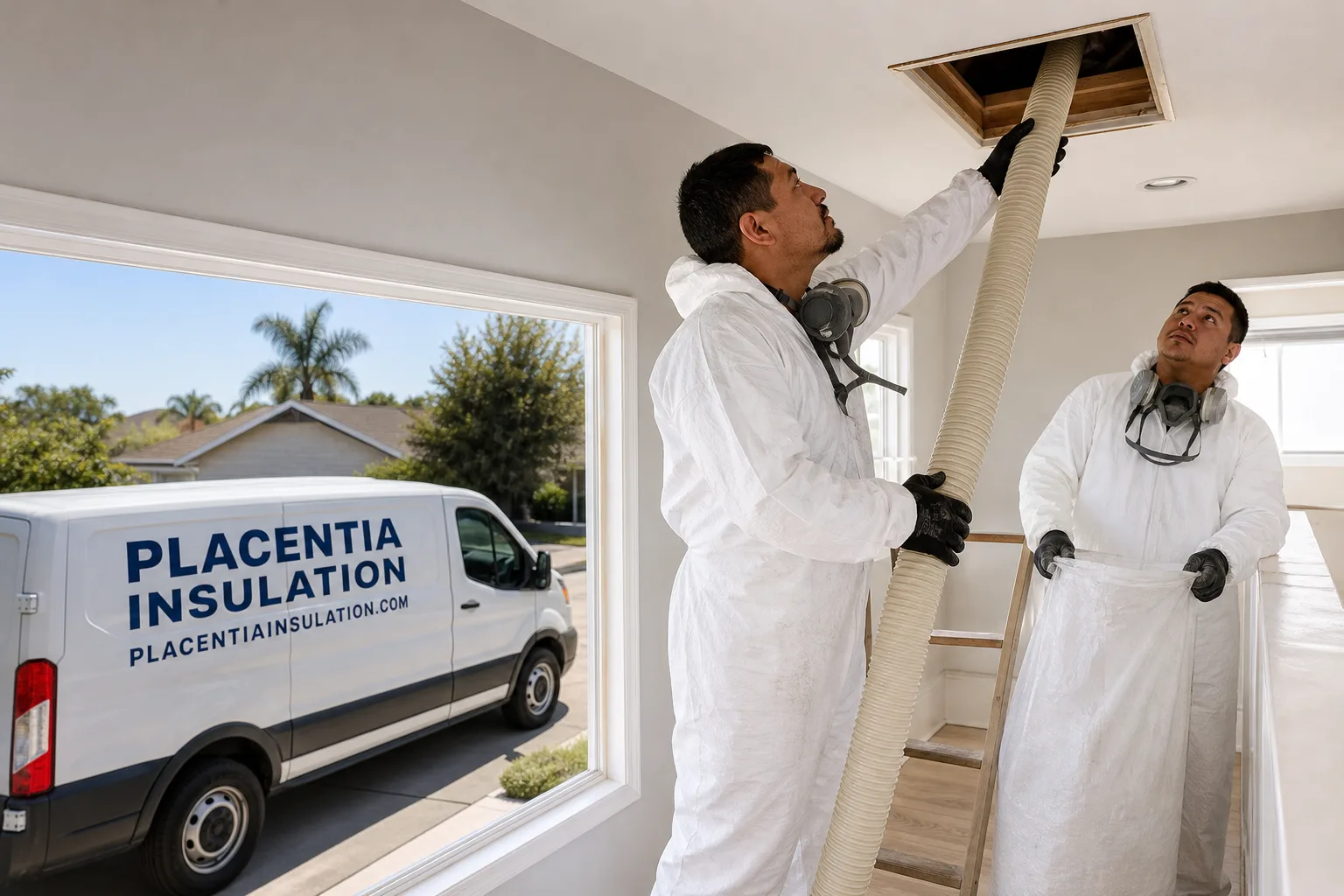
Trusted Spray Foam Insulation for Placentia Homeowners
Placentia Spray Foam Insulation typically costs $2.50 to $7.00 per square foot installed, with most whole-attic projects landing between $4,500 and $9,500 depending on foam type and square footage. We’re Placentia Insulation, and we’ve built our entire business around one trade: making homes in this city hold their temperature, resist moisture, and stop wasting energy. Led by Alan Whitcomb, our crews install both Icynene and Demilec spray foam systems, matched to the specific cavity, climate exposure, and performance goal of each Placentia home. Call (855) 773-6429 for a free assessment and a straight answer on what your house actually needs.
Closed Cell Spray Foam Insulation
Closed Cell Spray Foam Insulation is a high-density foam that cures into a rigid, moisture-resistant barrier with an R-value around R-6.5 to R-7 per inch, roughly double what fiberglass delivers in the same space. We specify closed-cell in Placentia when a home needs structural reinforcement, a vapor barrier in one pass, or maximum insulation in a tight cavity like a 2×4 wall. Placentia Insulation applies Demilec closed-cell systems for these jobs, and pricing in Placentia generally runs $3.50 to $7.00 per board foot. The material costs more than open-cell, but for certain applications – think flood-prone crawl spaces or garage walls shared with living space – it’s the only foam chemistry that makes sense.
Moisture and Vapor Control
Closed-cell foam is a Class II vapor barrier at about 1.5 inches of depth. That matters in Placentia’s older neighborhoods, where crawl spaces pick up ground moisture and unsealed rim joists let humid air move into the house. One pass with closed-cell handles the insulation and the moisture control together.
Structural Benefits in Retrofit Walls
When foam cures at 1.5 to 2 pounds per cubic foot, it adds racking strength to wall assemblies. For Placentia homes with older framing or stucco over open studs, that rigidity is a real structural upgrade – not just a thermal one. Alan has seen this make the difference on several 1960s-era Placentia remodels.
Open Cell Spray Foam
Open Cell Spray Foam is a lighter, softer foam that expands aggressively to fill irregular cavities, delivering roughly R-3.5 to R-4 per inch and excellent sound dampening. We recommend open-cell for most Placentia attic applications where there’s ample depth to work with, since you can build thickness without the weight or cost of closed-cell. Placentia Insulation installs Icynene open-cell systems, with typical Placentia pricing between $2.50 and $4.50 per board foot. It’s the right call when air sealing is the priority and the cavity isn’t exposed to standing moisture.
Air Sealing Before R-Value
Most energy loss in Placentia homes isn’t conduction through insulation – it’s air leaking through gaps, around recessed lights, and where drywall meets framing. Open-cell foam expands into those gaps and seals them. A home that’s airtight at R-30 outperforms a leaky house with R-49 fiberglass every time, and that’s the conversation Alan has with nearly every homeowner who’s fighting a hot upstairs.
Sound Reduction Between Rooms
Because open-cell foam stays soft and absorbs acoustic energy, it’s the better choice for interior walls and floors. Placentia homeowners who’ve added a home office or a rental unit have been surprised at the noise isolation. The foam doesn’t transmit sound the way rigid closed-cell can.
Spray Foam Insulation Contractors
Spray Foam Insulation Contractors are specialists who install two-component foam systems using heated, pressurized rigs – and in Placentia, choosing the right contractor matters more than choosing the right foam. Placentia Insulation is insulation-only, so our crews run spray foam jobs every week, not once a month between HVAC and roofing projects. For a whole-attic spray in Placentia, you can expect to pay between $4,500 and $9,500 — learn more about how much Spray Foam Insulation costs — while wall cavity injection and rim joist work fall at lower totals, usually $1,200 to $3,500. The bid you get should name the specific product – Icynene or Demilec – and the target depth. If it doesn’t, keep looking.
Single-Trade Focus Means Correct Applications
General contractors are good at many things; spray foam chemistry is rarely one of them. Our entire toolset, training budget, and daily schedule revolve around insulation. That focus is why we can talk honestly about when spray foam is overkill and when a Rockwool batt or GreenFiber cellulose makes more sense for a Placentia home.
Product Knowledge Across Eight Brands
We carry Owens Corning, Johns Manville, Knauf, Rockwool, CertainTeed, Icynene, Demilec, and GreenFiber. Most insulation contractors stock one or two product lines; we carry eight, which means the Placentia homeowner gets the material that fits the job, not the job forced onto the material the contractor happens to have in stock.
Spray Foam Attic Insulation
Spray Foam Attic Insulation replaces traditional fiberglass batts or loose-fill with an expanding foam applied directly to the roof deck, turning the attic into conditioned space and eliminating the 130-degree oven effect Anaheim Spray Foam Insulation customers know just as well. For a typical 1,200 square foot Placentia attic, open-cell spray runs $3,000 to $5,500, while closed-cell runs $4,500 to $8,500. We typically recommend open-cell for attics with sufficient rafter depth, since it provides the air seal at a lower material cost. The payoff shows up in the first August when the upstairs bedrooms finally hold the same temperature as the rest of the house.
Unvented Attic Conversion
When foam goes directly on the roof deck, the attic stops needing ventilation – ridge vents, soffit vents, and gable vents all become irrelevant. That’s a big deal for Placentia homes where existing venting is undersized or blocked. The entire attic volume joins the conditioned envelope, which changes how the HVAC system sees the house.
Ductwork in the Attic
Many Placentia homes run their supply ducts through the attic. In an uninsulated attic, those ducts sit in 120+ degree air and shed about 20% of their cooling energy before it ever reaches a register. Encapsulating the attic with foam puts the ducts inside the conditioned space, and that’s often the single largest efficiency gain available in older Placentia houses.
Spray Foam Wall Insulation
Spray Foam Wall Insulation fills stud cavities from the inside or outside, stopping the air movement that batt insulation in Placentia walls allows. For existing 2×4 walls, closed-cell at 3.5 inches brings the assembly to roughly R-23 plus a vapor barrier; for new 2×6 construction, open-cell is often the better value. Wall cavity spray in Placentia generally runs $1,800 to $4,200 per floor, depending on access and whether we’re working from the interior or exterior. Walls are where the heat gain fights you most directly in Spray Foam Insulation in Brea and Placentia summers — west-facing walls especially.
Retrofit Options Without Tearing Out Drywall
We can inject foam through small holes from the exterior or through the drywall from inside, then patch and finish. For Placentia homes with original 1950s and 60s stucco, the exterior route often preserves interior trim and paint. The foam fills around old wiring, plumbing, and blocking in a way batts never did.
West-Facing Wall Priority
Afternoon sun on a west wall in Placentia can push surface temperatures past 140 degrees. If a bedroom or living room on that side of the house is always the warmest room, the wall cavity is usually the culprit. Foaming those specific walls costs less than a whole-house wall package and addresses the discomfort where it actually lives.
Rim Joist Spray Foam
Rim Joist Spray Foam seals the thin band of framing where the floor system meets the foundation wall – the most consistently leaky part of any Placentia home with a basement or crawl space. A full rim joist package for a typical 1,500 square foot Placentia house costs $800 to $1,800 for open-cell and $1,200 to $2,500 for closed-cell. This is one of the highest-return insulation jobs available, because the rim joist is a wood-to-wood joint that’s nearly impossible to seal with anything but spray foam. Air, insects, and moisture all find their way through the rim joist before they find anywhere else.
Targeted, Not Whole-House
Rim joist work is a focused job, often done in a single morning. That makes it a good entry point for Placentia homeowners who want to test what spray foam can do before committing to a full attic or wall package. The air sealing improvement is usually measurable on the very next energy bill.
Rodent and Pest Entry Points
Mice and rats in Placentia get into houses through small gaps around the rim joist, where sheathing meets the sill plate. Closed-cell foam doesn’t just block air; it eliminates the openings pests use to enter. Add a steel mesh detail in high-pressure areas, and the entry path is gone.
Crawl Space Spray Foam Insulation
Crawl Space Spray Foam Insulation applies foam to the crawl space walls and rim joists rather than insulating the floor above, creating a sealed, conditioned crawl space that stops ground moisture and damp air from rising into the living space. Placentia crawl space encapsulation with closed-cell spray typically runs $3,000 to $7,000 depending on square footage and access height. Open-cell is not recommended below the floor line because it absorbs water, so we specify Demilec closed-cell here. Homes in older Placentia neighborhoods with vented crawl spaces see the biggest transformation – the musty smell, the cold winter floors, and the humidity that shows up as condensation on ductwork all trace back the same source.
Sealed Crawl Space Strategy
The science has shifted: vented crawl spaces in humid climates like Placentia’s bring in more moisture than they release. Sealing the vents and insulating the walls keeps the crawl space dry by keeping outside air outside. The floor above stays warmer in winter and the whole house smells different within a week.
Ductwork Below the House
When HVAC ducts run through a vented crawl space, they sweat in summer and lose heat in winter. Encapsulating the crawl space puts those ducts in a semi-conditioned buffer zone. For Placentia homes with forced air, this one change can cut heating and cooling loss by 10 to 15 percent.
Garage Spray Foam Insulation
Garage Spray Foam Insulation applies foam to the garage ceiling and shared walls to stop heat transfer between the garage and the living spaces it touches, whether that’s a bedroom above or a kitchen on the other side of the wall. Most Placentia garage insulation projects run $1,500 to $4,000, with the final number depending on whether we’re foaming the ceiling, one wall, or the entire garage. The garage is where a lot of Placentia homes lose their energy fight, because builders left it uninsulated and the thermal boundary just stops at the drywall. Foam closes that boundary properly.
Bedroom Over Garage Syndrome
If the bedroom above the garage is always the coldest room in winter and the hottest in summer, the garage ceiling is the reason. Heat moves through the uninsulated floor assembly into the garage attic, and from there out of the house. Foaming the garage ceiling puts a real barrier between that living space and the unconditioned garage below.
Shared Wall Air Sealing
Even when the garage ceiling is insulated, the wall between garage and house frequently leaks air around electrical penetrations and at the top plate. Closed-cell foam seals those bypasses and adds an ignition barrier in the process, which matters for Placentia code compliance when the garage is attached to living space.
Brands We Service
We install Icynene and Demilec spray foam systems, and we’re factory-trained on both product lines. Icynene open-cell is our first choice for attics and interior sound walls, while Demilec closed-cell handles the tougher jobs in crawl spaces and rim joists. Working with two manufacturers instead of one means the foam chemistry gets chosen for the application, not by default.
Beyond spray foam, we also work daily with Rockwool, CertainTeed, Owens Corning, Johns Manville, Knauf, and GreenFiber. Whether you already have Rockwool in your walls and need matching retrofit work, or you’re comparing CertainTeed batts against a spray foam upgrade, we can help you weigh it honestly. Placentia homes deserve a contractor who isn’t married to one brand’s catalog.
Signs You Need a Pro Right Now
- Upstairs rooms run 8 to 10 degrees warmer than downstairs. In Placentia summers, an attic that’s not air-sealed acts as a heat battery that radiates down through the ceiling all evening. Spray foam on the roof deck turns that attic into conditioned space and removes the heat source.
- Energy bills have climbed 20% or more year over year. Rising rates explain some of it, but a house that’s leaking conditioned air fights itself every day. Foam’s air-sealing is the difference between paying to cool air that stays inside and paying to cool the whole neighborhood.
- You can smell the crawl space from the living room. That musty odor means ground moisture is evaporating into the house. Sealed crawl space foam stops the moisture at the source instead of masking the smell.
- Cold floors in winter even with the heat on. Floor joists over an unsealed crawl space or a vented foundation lose heat constantly. Insulating below the floor plane changes the thermal boundary so the floor actually feels warm.
- Drafty rooms despite caulking and weatherstripping. You can seal every window and door and still have air moving through walls, rim joists, and recessed lights. Foam finds those hidden pathways and closes them all at once.
Our Process, Step by Step
- 1
Assessment and thermal walkthrough. We start by walking the house with you, going into the attic and crawl space, and mapping where heat is being gained and lost. Alan looks at the existing insulation, the orientation of the house, and the construction type before recommending anything.
- 2
Scope and material selection. Based on what we find, we specify the right product: Icynene open-cell for most attic applications, Demilec closed-cell for crawl spaces and rim joists, and occasionally a mineral wool or cellulose alternative where foam isn’t warranted. You get a written scope with target depths, not a vague promise.
- 3
Prep and masking. On install day, we mask off windows, floors, and anything that shouldn’t have foam on it. Occupants and pets stay out of the work area during the spraying, which typically runs four to six hours for a full attic.
- 4
Application and cure monitoring. Our crew applies the foam to the specified depth, checking thickness against manufacturer requirements as we work. Foam cures within minutes to hours depending on chemistry and humidity, and we verify adhesion before we leave.
- 5
Trim, cleanup, and walkthrough. After the foam cures, we trim any over-expansion, remove the masking, and walk you through what was installed and where. You get a report of the target vs. installed depth so there’s no guesswork.
How Much Does Spray Foam Insulation Cost in Placentia?
A typical attic spray foam project in Placentia runs $4,500 to $9,500, wall cavities cost $1,800 to $4,200 per floor, rim joist sealing runs $800 to $2,500, and crawl space encapsulation lands between $3,000 and $7,000. Open-cell runs $2.50 to $4.50 per board foot; closed-cell runs $3.50 to $7.00 per board foot. The price depends on square footage, access difficulty, foam depth, and whether we’re working over finished living space or in an open attic.
Things that push the price up include low-slope roofs that make spraying difficult, attics cluttered with old insulation that needs removal first, and homes where electrical or plumbing penetrations complicate the prep. The cheapest bid in Placentia is usually cheap because it’s thin – under-applying foam by half an inch is invisible once it’s sprayed, and it’s the most common shortcut in this trade. A free estimate from us includes the target depth in writing, not just a dollar amount. Call (855) 773-6429 and we’ll measure, quote, and explain the difference between what you’re paying for.
Our Service Area Near Placentia
We serve Placentia and the surrounding Orange County and Los Angeles County communities, including Spray Foam Insulation in Compton, Spray Foam Insulation in East Los Angeles, and Spray Foam Insulation in South Gate. We also work in Monrovia, San Gabriel, Arcadia, Alhambra, Walnut Park, Trabuco Canyon, Huntington Park, East Pasadena, and San Marino. Most Placentia jobs get scheduled within a week, and we run same-week estimates across the service area. If you’re checking our home page for service boundaries, we cover the whole corridor.
Serving Placentia, CA — Our Local Coverage Area
We’re based in the Placentia area and know this community well. Use the map below to see our service coverage — if you’re nearby, we can almost certainly help.
Frequently Asked Questions About Spray Foam Insulation in Placentia
Spray foam insulation is a two-component material that’s mixed on-site and applied as a liquid, then expands to fill the cavity and harden into an insulating, air-sealing foam. In Placentia, we install both open-cell and closed-cell systems from Icynene and Demilec, each suited to different applications. It differs from batt or blown-in insulation because it seals air leaks while it insulates, which addresses the real source of most energy loss in local homes.
A typical attic spray in Placentia is completed in a single day, usually four to six hours of spraying plus cure time. Rim joist sealing takes a morning; full wall retrofits run one to two days. We schedule prep and masking carefully so the work area is protected and the job finishes when we say it will.
Spray foam in Placentia ranges from $2.50 to $7.00 per board foot installed, with whole-attic projects between $4,500 and $9,500 and smaller scopes like rim joists from $800 to $2,500. The specific price depends on foam chemistry, depth, and access. Call (855) 773-6429 for a free, written estimate that names the product and target depth.
Yes, we’re factory-trained installers for both Icynene and Demilec spray foam product lines. Icynene open-cell handles attics and interior sound applications, while Demilec closed-cell covers crawl spaces, rim joists, and moisture-sensitive areas. We choose between them based on what the Placentia home actually needs.
For urgent situations like a failed insulation system after water intrusion or pest damage, call (855) 773-6429 and we’ll work to get a crew out as quickly as possible. We reserve same-week capacity for emergencies and always assess the underlying cause before re-insulating. The faster you call after a leak, the less damage the foam and framing absorb.
Both Icynene and Demilec back their foam products with manufacturer warranties, and our installation workmanship is covered under our own written warrant. The specifics depend on the product and application, so we document everything at install so there’s a record of what was applied and at what depth. Ask Alan for the warranty terms at your estimate.
Move personal items out of the work area, especially in attics and crawl spaces, and make sure the crew has clear access to the attic hatch, crawl opening, or wall areas being treated. Occupants and pets should stay out of the house during spraying and for the cure time we specify. We handle all masking and protection; you just need to give us access.
Schedule Your Spray Foam Insulation Service in Placentia Today
If your Placentia home has been fighting high energy bills, uneven room temperatures, or moisture in the crawl space, let’s find out why before you spend another season uncomfortable. Call (855) 773-6429 and Alan will schedule a free assessment, walk the house with you, and recommend exactly what your walls, attic, or crawl space need. No obligation, no pressure, just a straight answer from a contractor who works only in insulation.
Written by Alan Whitcomb, Owner at Placentia Insulation, serving Placentia homeowners with spray foam and insulation expertise.