
Icynene Attic Insulation in Placentia: A Homeowner’s Guide
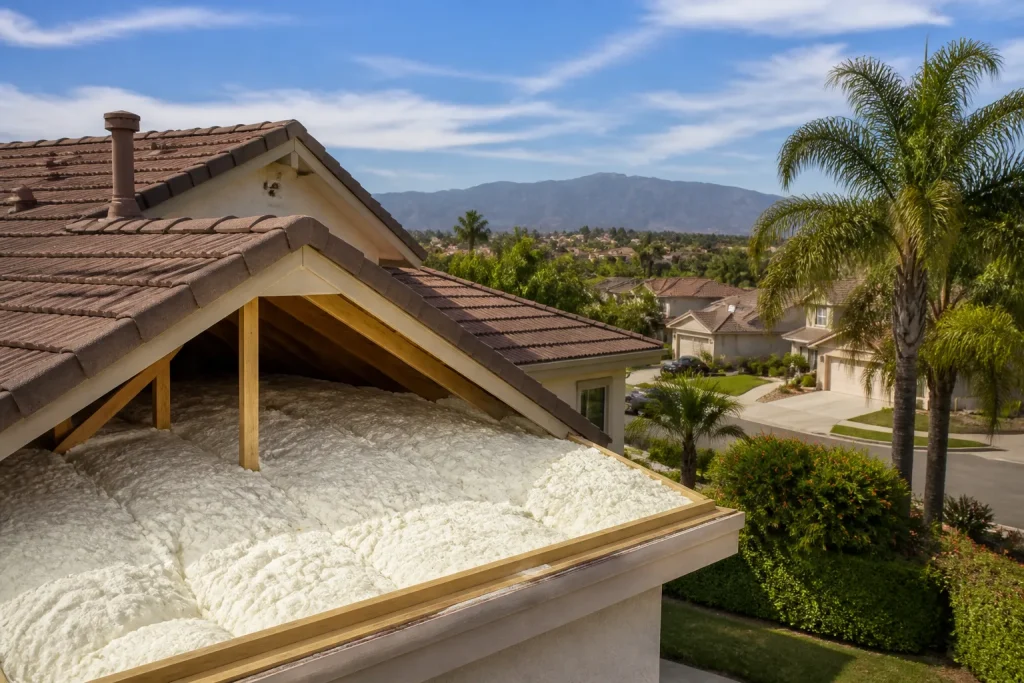
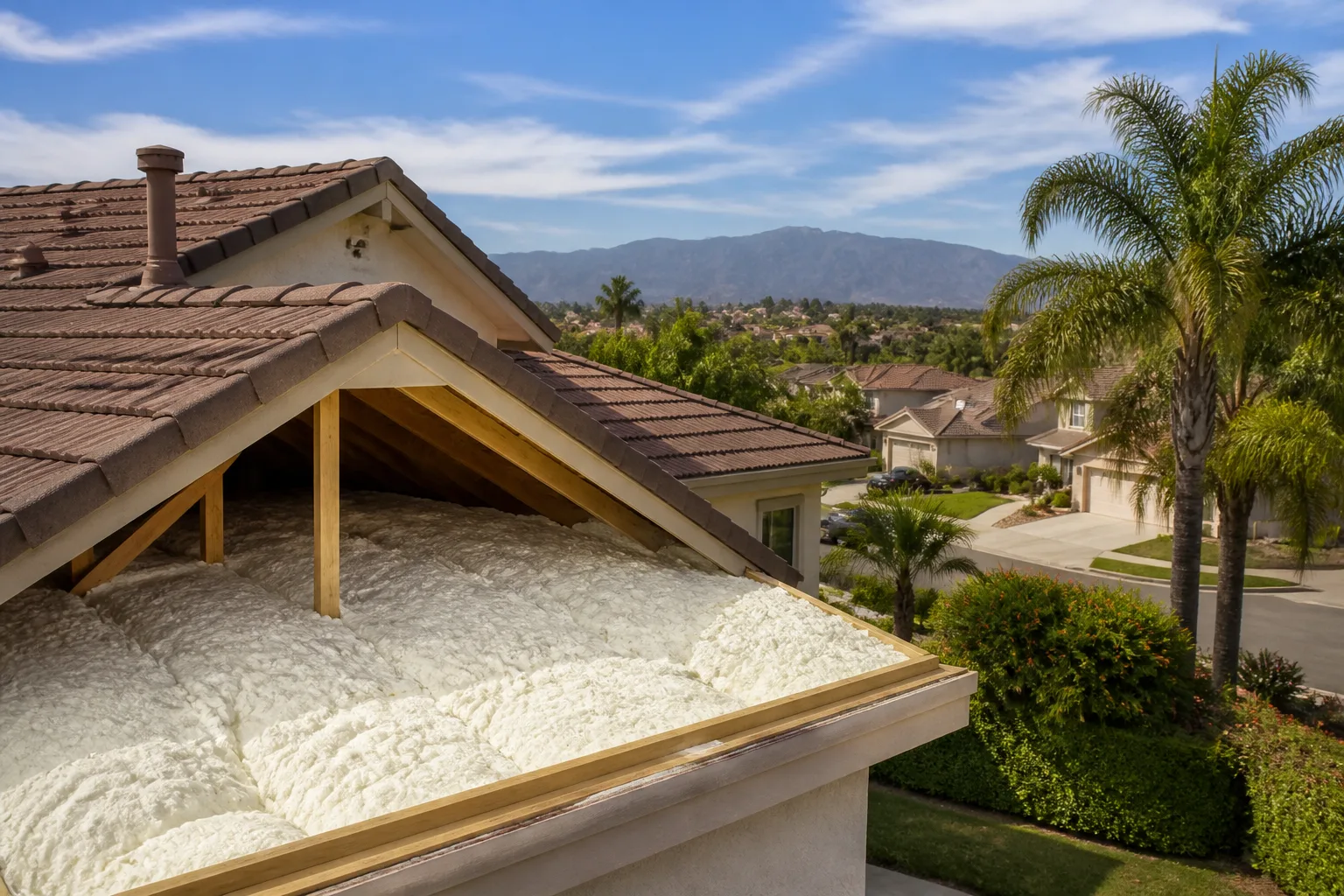
Icynene open-cell spray foam is a specific tool with a narrow sweet spot. It shines when sprayed on the roofline of a Placentia attic to create a conditioned, air-sealed space, especially when your HVAC ducts run through that attic. Sprayed on the attic floor of a standard vented attic, it delivers roughly the same thermal performance as blown-in cellulose at triple the price. The right question isn’t “Should I get Icynene?” It’s “Which part of my attic is actually losing energy, and what material fixes that specific problem?” If you’d rather skip hours of research and get a straight answer from a specialist, call us at (855) 773-6429.
Key Takeaways
- Icynene open-cell is an air-sealing product first, an insulator second. It earns its cost on the roofline, not the attic floor.
- Placentia homes with ductwork or air handlers in the attic are prime candidates for an Icynene-conditioned attic.
- Open-cell Icynene is vapor-permeable, which matters in Placentia’s mixed-humid climate. Some roof assemblies here need closed-cell Demilec instead.
- Installed pricing for Icynene in Placentia runs roughly $2.00 to $3.50 per board foot, depending on depth, access, and prep work.
- R-value alone tells a misleading story. Air sealing plus modest foam depth often outperforms thick fiberglass in a drafty attic.
What Icynene Actually Does Well in a Placentia Attic
Icynene is an open-cell spray foam. That means the foam cures into a soft, sponge-like matrix with tiny air pockets. It expands to roughly 100 times its liquid volume, filling gaps, cracks, and odd-shaped cavities. The material’s real strength is that it does two jobs simultaneously: it insulates and it air-seals. Fiberglass batts and blown-in cellulose insulate, but they don’t stop air movement. Air leaks through a fiberglass batt the same way it leaks through a wool sweater. Icynene stops the wind.
In a Placentia attic, that distinction matters more than most homeowners realize. Attics here bake in summer. Roof deck temperatures in August regularly exceed 140°F. If your attic is vented, that heat radiates down through whatever insulation sits on the attic floor. If your attic is conditioned, meaning the insulated boundary is the roofline itself, the heat never enters the living space’s thermal envelope. Icynene sprayed directly to the underside of the roof deck creates that conditioned boundary. That’s the application where it outperforms every other material we work with.
For a deeper look at how attic insulation works across Placentia home types, see our Attic Insulation in Placentia page.
The Roofline vs. Attic Floor Mistake That Costs Homeowners Thousands
Here’s the scenario we hear about most often when homeowners call us after getting a bad quote. A contractor proposes spraying Icynene on the attic floor. The homeowner pays $4,000 to $6,000 for the job. Six months later, their energy bills haven’t moved. Why? Because open-cell foam laid flat on an attic floor of a vented attic is doing the job that $800 worth of blown-in cellulose would do, at triple the cost.
Open-cell Icynene is not a significantly better floor insulator than cellulose or fiberglass of the same R-value. Its advantage is air sealing. And air sealing on the attic floor of a vented attic is nearly pointless, because the attic itself is designed to breathe. You’d be sealing against air movement in a space that deliberately exchanges air with the outdoors through soffit and ridge vents. The performance gain you paid for never materializes.
The correct application is on the roofline. When Icynene is sprayed on the underside of the roof deck, it seals the attic from the outside air. The attic becomes semi-conditioned space. The temperature in the attic tracks closer to the temperature of the house below, not the temperature of the shingles above. That’s where the energy savings come from. If a contractor proposes Icynene on your attic floor without explaining this distinction, get a second opinion. We’ve redone jobs in neighborhoods around Placentia where homeowners paid spray foam prices for a result that cellulose could have delivered. One we pulled out of a home off Yorba Linda Boulevard last spring was barely two inches thick in spots, and the roof deck itself was still in a vented configuration. The homeowner had paid for air sealing that physically couldn’t happen.
For comparison with other methods, review our Blown In Insulation in Placentia page.
When Icynene on the Roofline Is the Right Call in Placentia
The single strongest case for Icynene in this city is a home with HVAC equipment or ductwork running through the attic. This is extremely common in Placentia’s mid-century ranch homes, where the furnace or air handler sits in the attic and duct runs distribute air through the ceiling. In a vented attic, that equipment lives in a 140°F space in summer. Your air conditioner produces 55°F air, pushes it through a duct bathed in 140°F heat, and loses a measurable percentage of its cooling capacity before the air reaches the register. The U.S. Department of Energy has estimated that duct losses in unconditioned attics can account for 20 – 30% of a home’s total cooling energy. That’s not a small number on a Placentia summer bill.
Spray Icynene on the roofline of that attic, and the entire space drops from 140°F to something closer to 85 – 90°F. The ducts now live in semi-conditioned space. The air handler isn’t fighting a blast furnace. Your AC works less, the upstairs rooms cool faster, and the temperature difference from room to room evens out. That is the application where Icynene open-cell genuinely earns its cost. It’s also the application where we recommend it without hesitation.
There’s a secondary benefit worth mentioning: noise. Open-cell foam dampens sound well. If you have a noisy air handler or live under a flight path, conditioning the attic quietly reduces sound transfer. Rockwool mineral wool does this job more aggressively, and we carry both, but open-cell foam brings some acoustic benefit along for free.
Open-Cell vs. Closed-Cell: Placentia’s Climate Decides, Not the Sales Pitch
Icynene makes open-cell foam. Open-cell is vapor-permeable, meaning water vapor can pass through it. That’s sometimes fine and sometimes a problem. Placentia sits in a mixed-humid climate. We get hot, dry summers, but we also get cool winter nights and occasional heavy fog or rain. When you spray open-cell foam directly against the roof deck in certain roof assemblies, the foam allows moisture from inside the house to migrate up to the underside of the cold roof sheathing. If that sheathing stays cold enough for long enough, condensation forms. Left unaddressed, that leads to rot. In a climate like Placentia’s, we often recommend a closed-cell product like Demilec for unconditioned roof applications where the roof deck is in direct contact with the foam. Closed-cell foam has a higher R-value per inch and acts as a vapor retarder, protecting the sheathing from condensation. Icynene open-cell works when ventilation or a vapor barrier is part of the assembly design. It is not automatically the right foam for every roof.
This is where the product library question chips in. Placentia Insulation carries both Icynene open-cell and Demilec closed-cell. Most insulation contractors carry one or two product lines. We carry eight, including Knauf, Rockwool, and CertainTeed, so the answer is never “whatever the truck has loaded.” The material is chosen for the assembly, not the other way around. See our Spray Foam Insulation in Placentia page for how we approach foam chemistry decisions.
R-Value vs. Real Performance: What Actually Matters in a Placentia Attic
There’s a persistent myth that more R-value solves everything. It doesn’t. A standard vented Placentia attic with R-38 fiberglass on the floor will still lose a staggering amount of conditioned air through the ceiling below, because fiberglass doesn’t stop air movement. Stack effect pulls air up through the house, through light fixtures, through ceiling penetrations, through gaps around the attic hatch, and into the attic. That air carries heat with it. The fiberglass slows some heat transfer, but the air itself is a highway.
Icynene’s effective performance comes from what building scientists call air sealing, not from its nominal R-value. Open-cell Icynene runs about R-3.7 per inch. Closed-cell runs about R-6.5 per inch. Compare that to fiberglass at roughly R-3.2 per inch and you’d think the difference is marginal. But a 3-inch coat of open-cell Icynene on the roofline of a leaky attic will often reduce energy consumption more than 12 inches of fiberglass on the floor, because it eliminates the air exchange that was undermining everything. The R-value on the spec sheet is one number. The effective thermal resistance of the assembly is the number that appears on your SCE bill.
Thicker foam does not fix bad design. We’ve seen quotes for 5.5 inches of open-cell where 3.5 inches plus proper air sealing at the soffit and ridge would have done the job. Past a certain point, adding foam depth yields diminishing returns, especially when the marginal cost is another several hundred dollars per inch across a full attic. The right foam, at the right thickness, applied to the right surface, is how you get an attic that actually works.
That said, there are moments when a trained pro is non-negotiable. Spray foam installation involves high-temperature chemical reactions and pressure systems, and a botched job can leave voids, off-ratio foam, or worse. This is not a DIY product. If you’re reading this because your attic is unbearable in August, call us. We’ll assess the assembly and tell you honestly whether Icynene, Demilec, cellulose, or Rockwool is the right answer. If you just need more broad info first, see our Placentia Insulation home page.
What Does Icynene Attic Installation Cost in Placentia?
Let’s talk numbers. Spray foam is priced by the board foot, which is one square foot at one inch of thickness. In Placentia, Icynene open-cell installed on a roofline typically runs $2.00 to $3.50 per board foot. A 1,500-square-foot attic roof deck with 3.5 inches of foam means roughly 5,250 board feet, which lands between $10,500 and $18,000. That’s a real investment. Here’s a breakdown of what moves that number:
- Application surface: Roofline work costs more than attic floor work because of scaffolding, masking, and working overhead at height.
- Access: A low-pitch Placentia ranch roof with a walkable deck is far cheaper than a steep second-story roof with minimal clearance.
- Prep work: If you need old insulation removed, baffles installed, or air sealing done before foam goes in, that adds labor.
- Depth: Each extra inch of foam adds roughly $0.60 to $1.00 per board foot in material and labor.
- Applicator quality: Budget crews often spray off-ratio foam, under-spray corners, or fail to mask properly. You’ll pay for the redo later.
Is it cheaper to repair or replace attic insulation? If you’re asking whether to keep a vented attic and just re-blow the floor, the answer is almost always yes to blown-in. Cellulose through a blower truck costs $1.20 to $2.00 per square foot in Placentia. If you’re conditioning the attic because your ducts live up there, the Icynene roofline job isn’t competing with cellulose on price. It’s competing with another ten years of 20 – 30% duct loss. Run that math over a decade of Placentia summers and the foam starts to look reasonable. Call us at (855) 773-6429 for an exact quote on your attic. Estimates are free and we’ll tell you if Icynene isn’t the right material for your roof.
The Bottom Line
Icynene open-cell is a precision tool, not a universal upgrade. It belongs on the roofline of a Placentia attic when the goal is conditioned space or when ducts and air handlers sit in the attic and bleed energy year-round. It is a waste of money on the floor of a vented attic. Placentia’s mixed-humid climate means open-cell cannot be the default for every roof assembly. Some homes need closed-cell Demilec. Some homes don’t need foam at all. They need better cellulose and air sealing. The answer depends on the attic, the roof, the ducts, and the budget. If you’re in Placentia and want someone to look at your attic and give you a straight recommendation based on what’s actually up there, Placentia Insulation offers free estimates. Call (855) 773-6429. We’ll tell you what we’d do if it were our house.
Frequently Asked Questions
Icynene open-cell on a Placentia roofline runs $2.00 to $3.50 per board foot installed. A typical 1,500-square-foot attic roof deck at 3.5 inches thick lands between $10,500 and $18,000. Attic floor applications cost less, but open-cell on a vented attic floor rarely makes financial sense compared to blown cellulose at $1.20 to $2.00 per square foot. Call (855) 773-6429 for a precise quote after we see your attic.
In a vented attic with insulation on the floor, Icynene is not meaningfully better than cellulose or fiberglass of similar R-value, and it costs three to four times as much. Icynene outperforms both when sprayed on the roofline to create a conditioned attic, because it air-seals as it insulates. That’s the application where it changes your energy bill, especially if ductwork runs through the attic. We can assess which situation applies to your home.
Icynene can be installed in existing homes, including Placentia’s older ranch and two-story homes. The attic must be cleared of stored items, old insulation may need removal, and roof penetrations like vents and can lights require masking. Existing ducts and wiring complicate the job but don’t prevent it. We inspect the attic structure and roof assembly first to confirm open-cell is appropriate for your roof. Call us for a walkthrough.
For a conditioned Placentia attic, 3.5 inches of open-cell Icynene on the roofline is a typical starting point, delivering about R-13 plus air sealing. Deeper foam adds R-value but with diminishing returns. The more important variables are that the foam is continuous, properly adhered, and that soffit and ridge vents are handled correctly. More thickness cannot compensate for a poorly sealed assembly. A site visit tells us the right depth for your roof pitch and attic layout. Call (855) 773-6429 to schedule.
Written by the team at Placentia Insulation, serving Placentia since 2018.
Need Insulation Help?
Call Placentia Insulation — licensed & insured, here with fast after-hours help in Placentia.
(855) 773-6429