
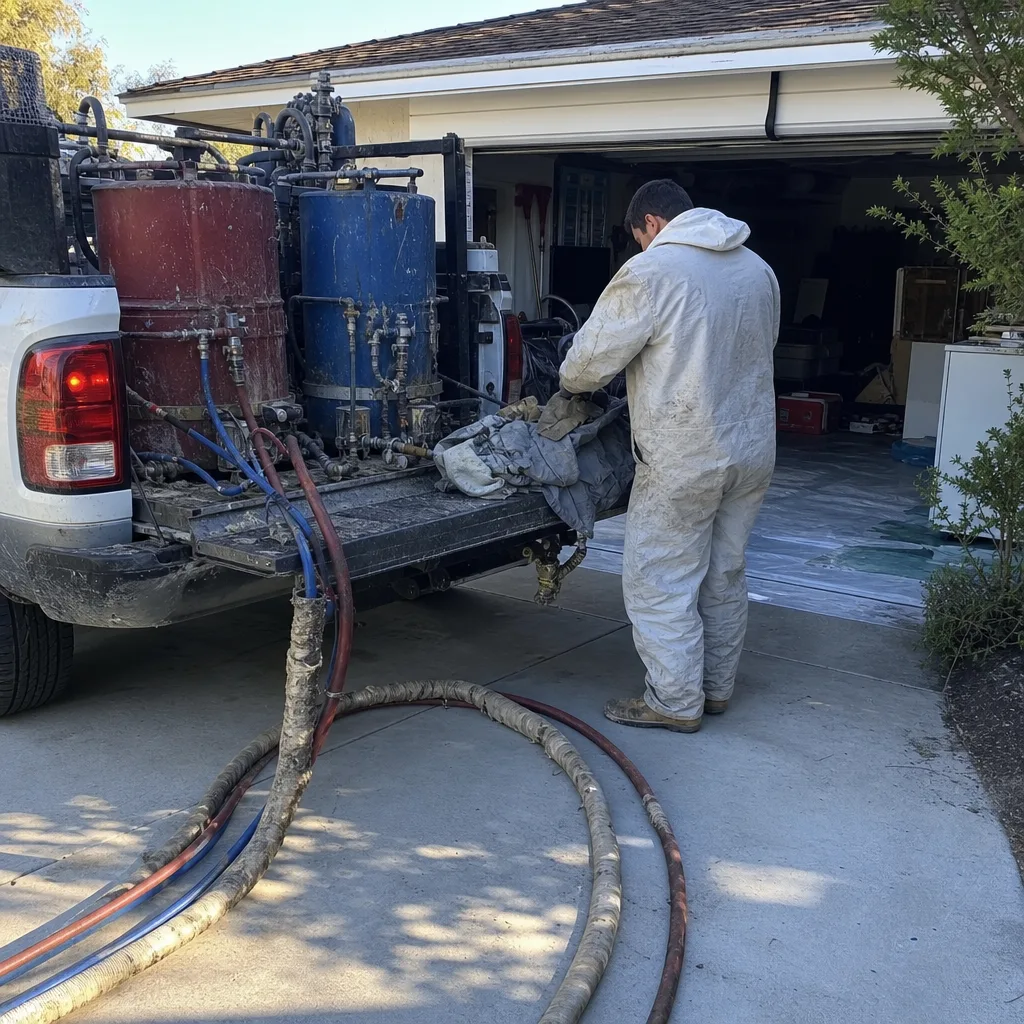
Fast, Reliable Spray Foam Insulation Across Bloomington
Spray foam insulation in Bloomington costs roughly $1.80 to $3.50 per board foot for open-cell and $2.50 to $5.00 for closed-cell, with a typical 1,500-square-foot attic running $4,000 to $9,000 depending on depth and access. Most Bloomington projects we handle are finished in one to two days. The real question isn’t whether spray foam works here. It’s whether the crew knows what a 1950s Valley Boulevard tract home actually needs, because foam installed wrong in a low-pitch attic creates problems instead of solving them. We’re Placentia Insulation, and we approach every Bloomington job as a retrofit problem first, not a material sale. Call (855) 773-6429 for a free estimate from a team that works these blocks regularly.
Why Placentia Insulation Is Bloomington’s Preferred Spray Foam Insulation Company
Bloomington’s housing stock isn’t a mystery to us. We’ve crawled through enough of these 1940s and 1950s stucco tract attics to know what’s waiting up there before we even open the hatch: compacted fiberglass batts, rodent nests in the corners, and heat that hits you like a wall by 9 a.m. in July. Our crews know which blocks along Valley Boulevard have the original knob-and-tube wiring still in place, which subdivisions got a half-hearted blow-in upgrade in the 1980s, and which low-pitch roofs simply don’t vent no matter what you do. That local knowledge changes how we spec foam, where we seal first, and what we tell you to expect. We’re not guessing from a map. We’re working from experience in your neighborhood.
Bloomington homeowners call us because we answer the phone as an insulation company, not a handyman service that happens to own a foam rig. Alan Whitcomb leads a team that carries both Icynene open-cell and Demilec closed-cell foam, so we pick the chemistry that fits the assembly, whether that’s a roof deck that needs to breathe or a rim joist that needs a vapor seal. Eight brands. Three methods. One specialty. That’s not a slogan; it’s how we avoid showing up with whatever’s left on the truck.
Spray Foam Wall Insulation in Bloomington
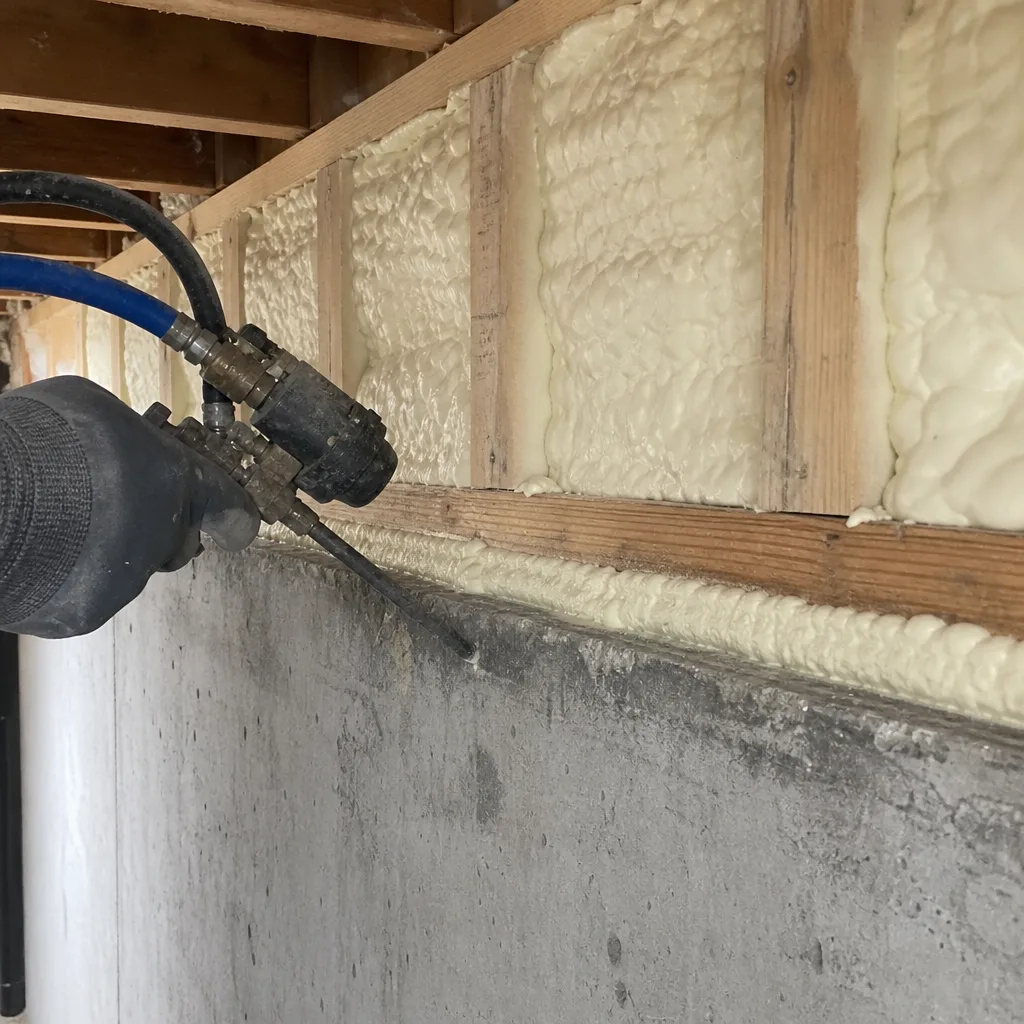
Spray foam wall insulation in Bloomington means air-sealing the exterior envelope of a house that was almost certainly built before anyone talked about blower-door tests or ACH50. We regularly open up walls in 1950s tract homes along Valley Boulevard and find nothing but a thin layer of newspaper or an empty cavity. The job involves either injecting open-cell foam into existing closed walls with a low-pressure rig or installing it during a re-siding or drywall-off remodel. Material cost for wall foam in Bloomington runs $2.00 to $4.50 per board foot installed, and a full exterior wall retrofit on a 1,200-square-foot home typically lands between $3,500 and $7,000. Closed-cell runs higher because the R-value per inch is nearly double open-cell, and the vapor profile matters when you’re sealing a wall that faces a hot western exposure in 92316.
When Closed-Cell Is the Right Call
Bloomington’s summer heat doesn’t just make rooms uncomfortable. It drives moisture into wall cavities when interior air conditioning meets hot exterior sheathing. Closed-cell Demilec creates a Class II vapor retarder at two inches, which stops that condensation cycle in its tracks. We spec it for west-facing walls and any assembly where bulk water intrusion is a known issue. It’s more expensive, but it’s the difference between foam that insulates and foam that also protects the framing.
Open-Cell for Interior Walls and Sound Control
Open-cell Icynene costs less and fits tight framing bays more easily because it expands aggressively and then cures soft. In Bloomington homes near the BNSF rail corridor along Valley Boulevard, we’ve used open-cell in interior partition walls specifically to cut train noise from the tracks. It’s not a substitution for closed-cell where moisture control matters. It’s a different tool for a different job.
Rim Joist Spray Foam in Bloomington
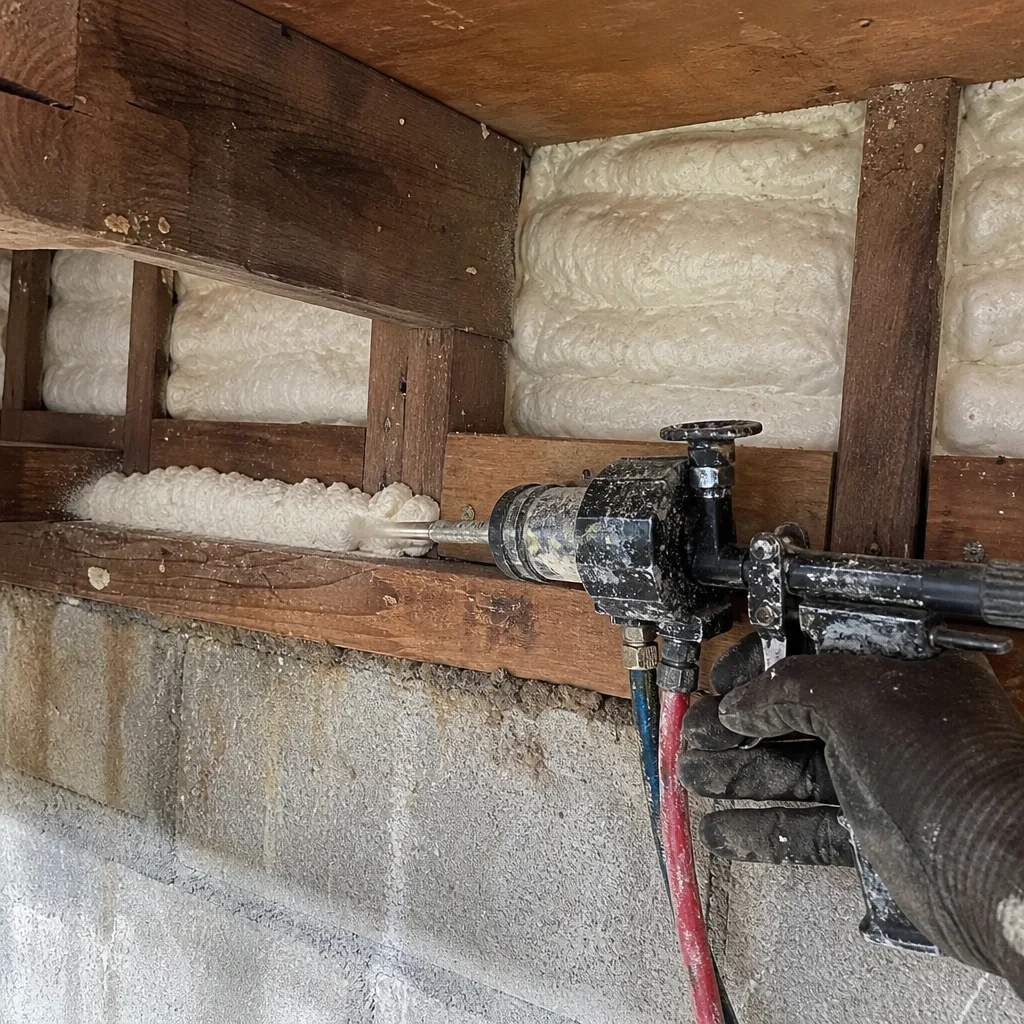
Rim joist spray foam in Bloomington targets the single largest air leak in almost every pre-1970 slab-on-grade home here. The rim joist is the band of wood where the floor framing meets the foundation, and in Bloomington’s original citrus-era housing stock it’s typically uninsulated, unsealed, and open to whatever crawls through the crawlspace or the exterior sheathing gap. Sealing it with two inches of closed-cell foam costs $1,200 to $2,800 for a typical 1,000 to 1,600-square-foot home, depending on how many linear feet of joist need coverage and how much of it is accessible. The payback in a Bloomington winter, when night temps drop into the low 30s, is immediate: floors stop cold-soaking and the furnace runs measurably less.
The Demilec Rim Joist Spec
We use Demilec closed-cell for rim joists because of the moisture profile. It cures to a rigid, air-impermeable layer with an R-value near R-7 per inch, and it won’t wick groundwater moisture the way open-cell would in direct contact with the sill plate. In Bloomington’s slab homes, the sill plate sits on concrete, and that concrete wicks ground moisture into the wood every day. Closed-cell isolates it. It also blocks the ant and spider traffic that finds these gaps like a highway.
Roof Deck Foam and Rim Joist Sequencing
When Bloomington homeowners do a roof deck foam job, we always check the rim joist in the same visit. They’re part of the same air boundary. If you foam the deck but leave the rim joist open, conditioned air still escapes at the floor line, and the attic assembly doesn’t see the full benefit. We sequence them together because the building envelope doesn’t end where the roof framing stops.
Trusted Brands We Service in Bloomington
Placentia Insulation runs both Icynene and Demilec products on our Bloomington trucks, and we carry the manufacturer’s recommended sealants, ventilation components, and application-specific foams for each system. That matters because Bloomington’s older attics need specific product choices, not whatever a single-brand shop has in the warehouse. We also spec CertainTeed air-sealing components and, where a mineral wool fire barrier is needed, Rockwool. Most insulation contractors in the Inland Empire carry one or two product lines. We carry eight, so the foam you get is the foam the assembly demands.
Common Spray Foam Insulation Problems We See in Bloomington Homes
- Compacted and animal-nested original insulation: In the 1940s through 1970s tract homes that line Valley Boulevard and the surrounding blocks, the original fiberglass batts have often been walked down by decades of service visits, rodent nests, and general neglect. Foam sprayed over compacted material leaves the old contamination in place and reduces the final R-value. We remove it first.
- Low-pitch roof heat trapping: Bloomington’s older homes were framed with 3:12 and 4:12 roof pitches and minimal eave venting. The attic air space gets superheated by mid-morning and the heat saturates the ceiling drywall. Foam installed without an air-sealing plan can trap that heat against the roof deck and shorten shingle life. We account for venting before we spec foam depth.
- Pre-1978 attic materials: Many of these attics contain vermiculite, old batt facings, or other materials that predate current handling standards. Spraying foam directly over them seals in whatever’s there and ruins the install. We identify and safely remove or encapsulate these materials before foaming. Skipping that step is a fast way to ruin a good job.
- Rim joist gaps and pest intrusion: In Bloomington’s slab-on-grade homes, the space between the floor deck and foundation is often open enough to see daylight. That’s where the cold comes in, and it’s where ants, termites, and rodents find entry. One rim joist sealing pass typically reduces heating demand in winter by more than any single interior upgrade.
Pricing for Spray Foam Insulation in Bloomington, CA
Spray foam pricing in Bloomington reflects the age of the housing stock and the access challenges that come with it. Here’s what we quote on a daily basis for 92316 homes:
- Open-cell roof deck spray foam: $3,200 to $6,500 for a 1,000 to 1,500-square-foot attic, depending on depth (typically 5 to 7 inches) and whether old insulation needs removal first.
- Closed-cell roof deck spray foam: $5,500 to $11,000 for the same footprint, with the higher end applying to low-slope roofs with poor access and the need for pre-1978 material handling.
- Spray foam wall insulation (existing closed walls): $2,000 to $5,500 for a whole-home injection project, or $2.00 to $4.50 per board foot when opened during a remodel.
- Rim joist spray foam: $1,200 to $2,800 for a typical Bloomington slab home.
- Attic air-sealing before foam: $800 to $1,500, which includes sealing top plates, wire penetrations, and the rim joist band before foam goes down.
What changes the price in Bloomington: whether we’re removing compacted or animal-nested insulation first, whether the attic has knob-and-tube wiring that needs clearance work, and whether the roof pitch is low enough to make access genuinely difficult. We quote all of this before we start. Call (855) 773-6429 for a free estimate, and we’ll give you a line-item number based on your actual attic, not a square-footage guess.
Key Takeaways: Spray Foam in Bloomington Homes
- Bloomington’s postwar tract homes were built with minimal attic insulation, and much of it has compacted or degraded decades ago.
- Low-pitch roofs with minimal eave venting make proper foam depth and air-sealing sequencing critical here, more so than in newer subdivisions.
- Rim joist sealing is the highest-ROI winter upgrade for Bloomington’s slab-on-grade homes, often cutting floor cold-soaking within days.
- We carry both Icynene open-cell and Demilec closed-cell, so we match foam chemistry to the assembly rather than defaulting to one product.
- Free estimates are built on an attic walk-through, not a square-footage phone quote. Call (855) 773-6429.
We Also Serve Cities Near Bloomington
Our crews run routes from Bloomington into Fontana, Rialto, Glen Avon, and Pedley every week. If you’re in one of those cities and dealing with the same 100°F attic bake we see here, we’ll bring the same full Spray Foam Insulation service and the same brand-matched material approach to your job. Same crews, same standards, no distance markup.
Serving Bloomington, CA — Our Local Coverage Area
We’re based in the Bloomington area and know this community well. Use the map below to see our service coverage — if you’re nearby, we can almost certainly help.
FAQs About Spray Foam Insulation in Bloomington
Attic temperatures in Bloomington routinely exceed 100°F by mid-morning in summer because the low-pitch roofs on this city’s 1940s to 1970s tract homes have minimal eave venting and the sun bakes the roof deck directly. Spray foam, especially closed-cell applied to the roof deck, stops the heat transfer at the roof plane rather than letting it radiate into the attic airspace. But it’s not a standalone fix; we also seal rim joists and top plates so the conditioned interior air stops leaking into the attic in the first place. Call (855) 773-6429 for a heat-load walkthrough, and we’ll tell you exactly what your attic is doing.
No, and we won’t even propose it. Spray foam needs a clean, continuous substrate to bond and perform. In the older Bloomington tract homes off Valley Boulevard, the original farmhouse-era batts are often compressed flat by years of foot traffic, soiled by rodents, and full of gaps. Spraying over that seals in the contamination and leaves a thermal bridge underneath the good material. We remove the old insulation first, inspect for wiring and pre-1978 materials, then foam directly on the roof deck or wall sheathing. The removal cost is already factored into your Bloomington quote.
The first step is identifying what’s actually up there. In Bloomington’s 1950s housing stock, we often find vermiculite, old kraft-faced batts, or degraded paper vapor barriers that predate current handling standards. We treat those as regulated materials, which means we don’t disturb them by hand, we follow containment and removal protocols, and we verify the attic is clean before any foam is sprayed. It’s slower and it costs a bit more, but it protects the foam install and the people living in the house. We’ve done this on dozens of Valley Boulevard homes, and we’ll show you what we found before we proceed.
Closed-cell, almost always. In Bloomington’s slab-on-grade tract homes, the rim joist sits directly against the concrete foundation, and that concrete wicks moisture into the sill plate all year long. Open-cell foam is vapor-permeable, which means it would let that moisture move into the floor framing and sit there. Closed-cell Demilec cures to a rigid, air-impermeable layer that acts as a vapor retarder and keeps the wood dry while it insulates. It costs more than open-cell, but it’s the right chemistry for the location, and that’s not a place where we compromise.
They do, but they serve different functions. Radiant barriers reflect radiant heat from the roof deck back out of the attic, which reduces cooling load during Bloomington’s 100°F summer stretches. Wall and rim joist foam slow conductive and convective heat transfer through the building envelope. Together, they drop both the attic heat gain and the floor-level cold infiltration that Bloomington sees every winter. We spec them as one envelope package, with the foam sealing the air boundary and the radiant barrier handling the radiant load. It’s the most common combined upgrade for older 92316 homes, and it’s one we’ve done many times.
Call Placentia Insulation for Spray Foam in Bloomington
We work Bloomington’s older tract housing stock because we understand what those attics need and what they’ll fight back with. If your floors are cold in January, your upstairs rooms run 10 degrees hotter than the rest of the house, or your attic cooks every summer, we’ll walk it with you and give you a straight answer. No pressure, no vague estimates, no foam sold as a cure-all. Alan Whitcomb and the Placentia Insulation team are ready to schedule your free Bloomington attic assessment. Call (855) 773-6429 today, and we’ll get a crew out to your block this week.
Written by Alan Whitcomb, Owner at Placentia Insulation, serving Bloomington and the surrounding Inland Empire since the company’s founding.