
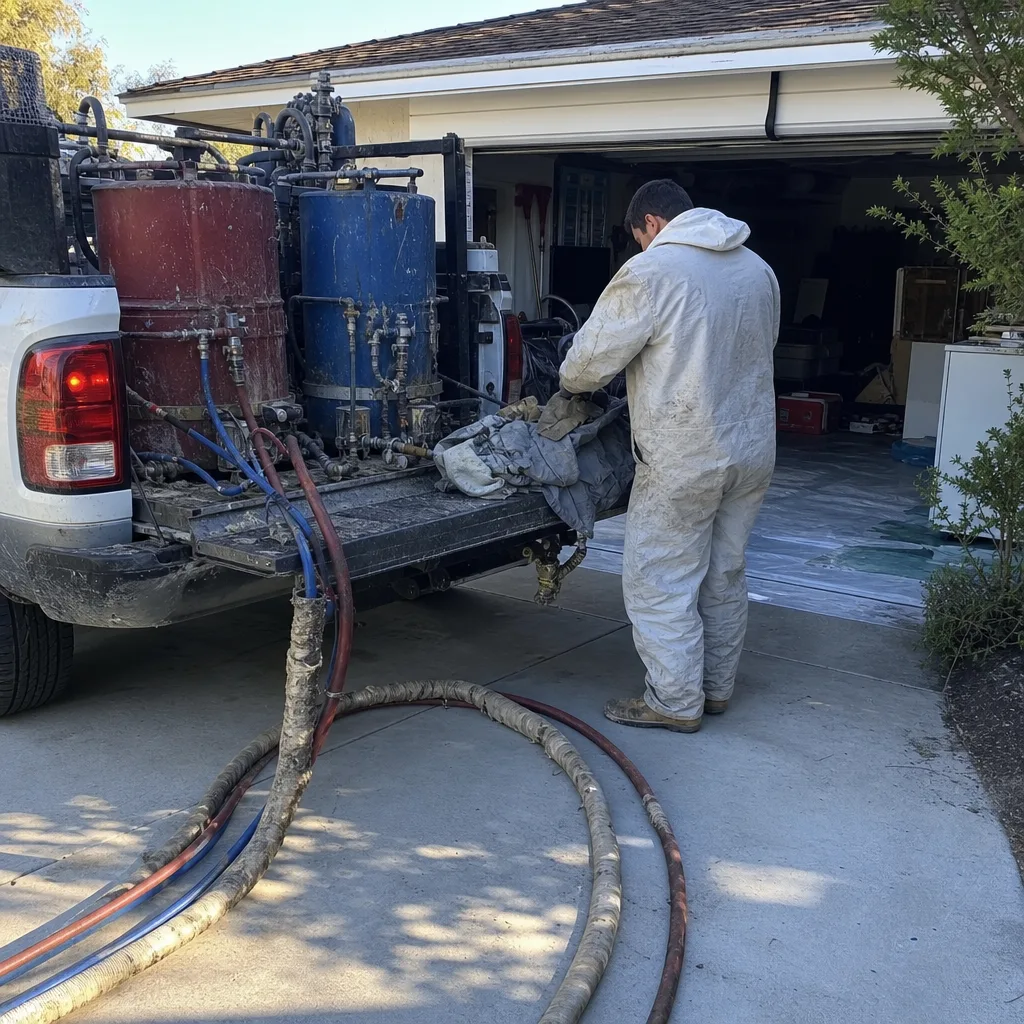
Fast, Reliable Spray Foam Insulation Across Fountain Valley
Spray foam insulation in Fountain Valley runs $1.80 to $4.50 per board foot for open-cell and $2.50 to $6.00 per board foot for closed-cell, with most whole-home jobs landing between $4,000 and $12,000 depending on square footage and cavity access. We’re Placentia Insulation, and we’ve been working inside Fountain Valley attics and wall assemblies long enough to know that the real cost driver here isn’t the foam itself. It’s the house. The slab-on-grade, 1958-to-1980 tract stock that dominates 92708 and 92728 was built when energy was cheap and insulation was an afterthought. We work those homes every week, and we know where they leak, where they sweat, and where spray foam actually pays for itself. Our Fountain Valley response time is typically same-day for calls and next-day for site assessments, depending on our crew schedule. Call (855) 773-6429 to have someone from our Spray Foam Insulation team take a look at your specific attic or wall condition.
Key Takeaways:
- Rim joist spray foam in Fountain Valley typically runs $1,500 to $3,200 for slab-on-grade ranch homes.
- Fountain Valley’s Title 24 reroof trigger, not your utility bill, is often what brings homeowners to us first.
- We stock both Icynene open-cell and Demilec closed-cell, so we can match chemistry to your 1960s stucco assembly rather than forcing one product.
- Most Fountain Valley homes we see have settled loose-fill reading R-6 in the attic despite what the original spec said.
Why Placentia Insulation Is Fountain Valley’s Preferred Spray Foam Insulation Company
We’re not a general contractor running an insulation side gig. Every crew member we send into Fountain Valley is an insulation-only specialist, and every conversation we have starts with the building envelope, not a menu of unrelated services. Fountain Valley homeowners call us because, frankly, the housing here is predictable in its problems. That predictability is an asset when you use it. We know that a single-story ranch off Talbert Avenue with original stucco walls and a 3:12 roof pitch is going to have specific attic bypass patterns. We know that homes west of the 405 get more afternoon wall heat than homes tucked behind Mile Square Park’s tree canopy. None of that comes from reading city data. It comes from years of pulling open attic hatches at 2 p.m. in August and actually measuring what’s happening up there.
Our lead, Alan Whitcomb, has spent his career in this one trade. His approach for Fountain Valley is blunt: the house tells you what it needs, and if you’re not listening to the house, you’re guessing. That’s why we carry eight insulation brands: Owens Corning, Johns Manville, Knauf, Rockwool, CertainTeed, Icynene, Demilec, and GreenFiber. Most contractors stock one or two and sell you what’s on the truck. We stock eight so we can match the material to the assembly. In a 1964 Fountain Valley stucco ranch with no sheathing and no drainage plane behind the stucco, that decision matters more than people realize. Closed-cell foam flashed against the wrong substrate can trap moisture in ways that open-cell won’t. Our customers in Fountain Valley appreciate that we talk about those distinctions before we ever quote a number.
Rim Joist Spray Foam in Fountain Valley
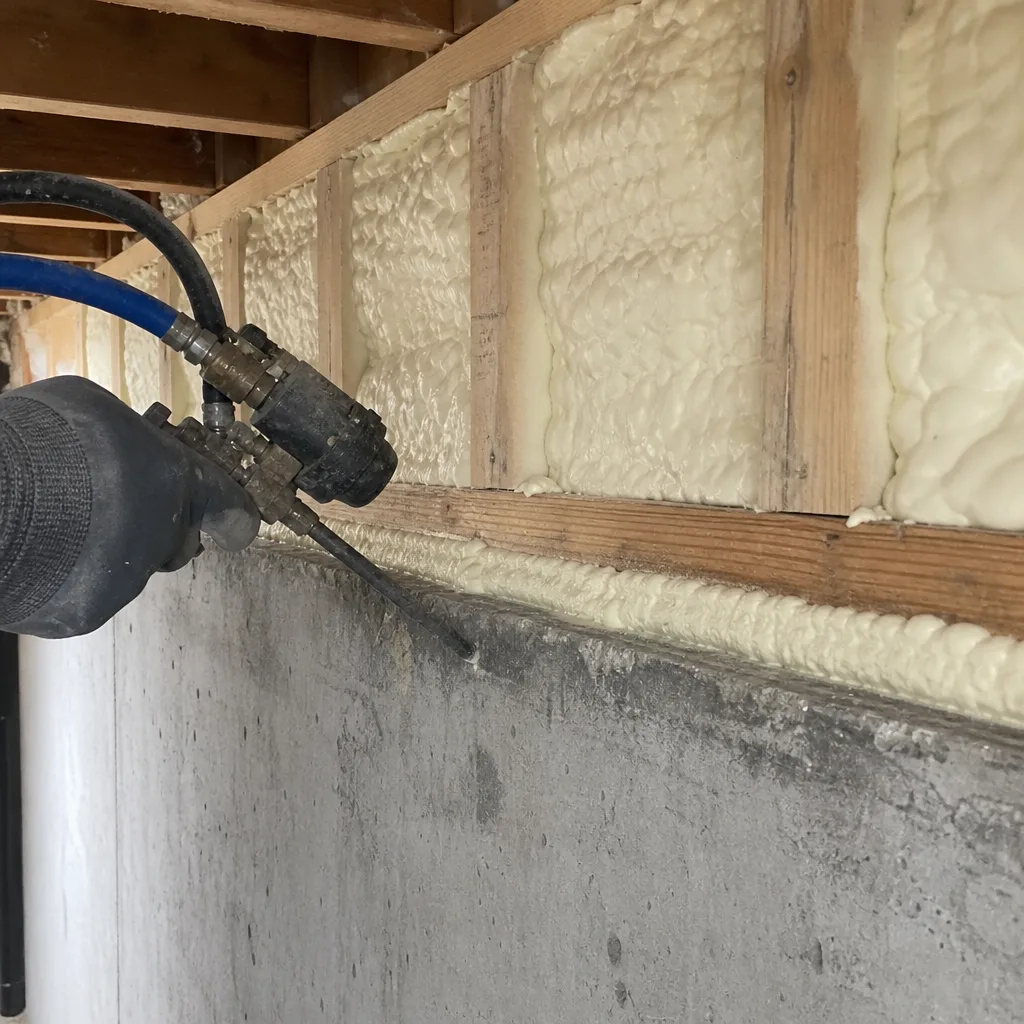
Rim joist spray foam in Fountain Valley is the most underrated insulation job there is, largely because it addresses a leak that almost nobody can see. In your typical 1960s single-story ranch, the rim joist, the framed band where the floor meets the exterior wall, was left unsealed by the original builder. Air moves freely between the outside and the conditioned space through the seam between the sill plate and foundation, and on slab-on-grade homes, which dominate Fountain Valley, that seam runs around the entire perimeter. You can feel it on a cool morning: a draft along the baseboard with no obvious source. That’s the rim joist. We seal it with Demilec closed-cell foam applied directly to the band from the interior side, typically through the drywall chase or by opening a small access panel. The closed-cell foam acts as both an air seal and a vapor barrier, which is exactly what that transition needs.
Why Slab-on-Grade Makes the Rim Joist the Priority
In a raised-foundation home, the rim joist is one problem among several: you’ve got a crawlspace, floor joists, and subfloor assembly all interacting. Fountain Valley’s slab-on-grade tract homes flip the emphasis. There’s no crawlspace to insulate, no floor assembly to address. The rim joist is the only horizontal air barrier between the inside of your house and the dirt and outside air around the slab edge. That’s why we put it first. A typical rim joist sealing job in Fountain Valley runs $1,500 to $3,200 depending on linear footage and access, and on a 1,400 square foot ranch, we can usually do it in a single day.
What Happens If You Skip It
If the rim joist stays unsealed while you add attic insulation, you’re effectively tightening one surface and leaving another wide open. The stack effect pulls outside air in through the rim and pushes conditioned air out through the attic, so your new attic insulation underperforms the spec sheet. The efficiency gain you paid for leaks out along the baseboards. We flag this on every Fountain Valley assessment because on slab homes, it’s the difference between a foam retrofit that solves the problem and one that just moves it around.
Crawl Space Spray Foam Insulation in Fountain Valley
Crawl space spray foam insulation in Fountain Valley is, for most homes here, a non-issue in the literal sense: slab-on-grade means no crawlspace. That’s the reality of the city’s original 1958-to-1980 housing stock, where builders poured slabs directly on the former lima bean and celery fields rather than raising foundations. But a significant slice of Fountain Valley homes, particularly two-story builds from the late 1970s and early 1980s in the 92708 ZIP, do have partial or full crawlspace sections under room additions or split-level layouts. When they do, those crawlspaces carry the same coastal humidity profile as the rest of the city: marine layer mornings, warm afternoons, and a real risk of condensation against uninsulated ducting and floor joists. For those homes, closed-cell spray foam applied to the crawlspace ceiling or band joist area stops the moisture cycle short.
When a Crawlspace Is Actually a Wall Problem
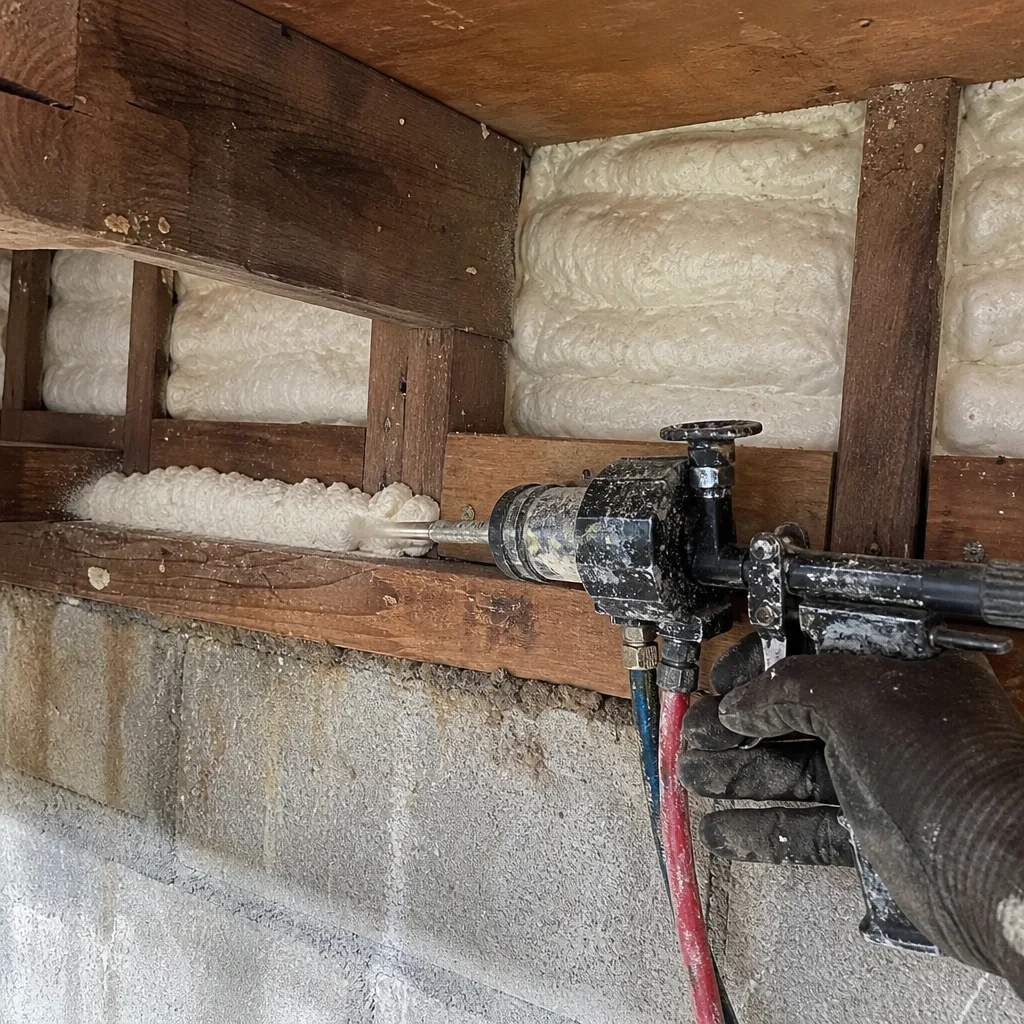
On Fountain Valley homes with a partial crawlspace, the transition between the slab portion and the raised portion is the weak point. The floor assembly changes height, the rim joist runs into the slab edge, and air finds the seam. We spray closed-cell foam along the rim joist and the slab-to-wall transition as one continuous envelope rather than treating the crawlspace as a separate job. That integration is where the specialist focus shows. A crawlspace rim and band seal in Fountain Valley typically runs $1,200 to $2,800 depending on access height and linear footage.
The Stucco Drying Path
Fountain Valley’s stucco exteriors matter here. Older stucco walls in this city are three-coat systems over paper-backed lath, and they dry to the outside. If you spray closed-cell foam against the interior side of a stucco wall with no drainage plane behind it, you’ve cut off that outward drying path. That’s a real problem in a marine-influenced climate where winter mornings start at 55 degrees and 85 percent humidity. We address it by leaving the stucco side able to breathe, which means choosing the right foam chemistry and application thickness for each wall section, just as we do for Reflectix repair in Fountain Valley. This is exactly the kind of decision a generalist contractor misses, and it’s why we carry both Icynene open-cell and Demilec closed-cell in our Fountain Valley service area.
Trusted Brands We Service in Fountain Valley
Placentia Insulation stocks and installs Icynene and Demilec spray foam systems in Fountain Valley, which matters for one practical reason: the right foam chemistry for a 1964 slab-on-grade stucco ranch off Bushard Street is not the same as the right chemistry for a 1985 two-story with a full crawlspace near the Fountain Valley Recreation Center. We carry both open-cell and closed-cell, and we’re certified through both manufacturers’ installation programs. That means Fountain Valley customers get the correct material for their assembly, not the one product the installer happens to sell. We also maintain full access to GreenFiber and Owens Corning for hybrid projects where blown-in cellulose or fiberglass makes more sense in specific cavities. Local parts and material availability are not an issue: our Placentia supply yard carries inventory specifically staged for Fountain Valley jobs, which keeps us moving fast when a reroof is pending and the inspector is waiting on the insulation sign-off.
Common Spray Foam Insulation Problems We See in Fountain Valley Homes
- Settled loose-fill that reads R-6 instead of R-11. The original builders put fiberglass batts or loose-fill into shallow 1960s roof cavities, and fifty years of heat, weight, and gravity have compacted it. The label says one number, but the actual thermal resistance is far less, and the west-facing afternoon sun on those shallow-pitch attics makes it worse.
- Attic bypasses above 2×4 wall tops. In many Fountain Valley ranch homes, the top plates of the original 2×4 walls open directly into the attic with no sealing. Marine-layer air moves down through those gaps into the living space, short-circuiting any new insulation you add. If we don’t seal those transitions, the R-value gain underperforms the spec sheet.
- Closed-cell foam trapping coastal humidity against old loose-fill. Spray foam done wrong on a 1960s Fountain Valley attic without addressing the existing settled insulation can create a vapor sandwich. The old loose-fill stays moist, condensation forms, and the smell of mildew follows. We see this on retrofit jobs where another contractor sprayed foam over the top of old material without sealing or removing it first.
- Rim joist foam pushing vapor into the wall cavity. On slab-on-grade homes with no crawlspace ventilation, a rim joist seal that doesn’t respect the stucco drying path can drive moisture into the wall cavity. The foam does its job as an air seal, but the vapor has to go somewhere. If the stucco can’t dry outward, you’ve created a slow leak inside the wall. Fountain Valley’s morning marine layer makes this a year-round concern, not a seasonal one.
Pricing for Spray Foam Insulation in Fountain Valley, CA
Here are real numbers for the Fountain Valley market, not national averages. Open-cell spray foam runs $1.80 to $4.50 per board foot installed. Closed-cell runs $2.50 to $6.00 per board foot. A typical whole-attic open-cell job in a 1,200 square foot Fountain Valley ranch runs $3,500 to $5,500, while closed-cell on the same attic runs $6,000 to $9,000. Rim joist sealing runs $1,500 to $3,200. Garage ceiling spray foam runs $1,800 to $3,500 for the typical single-car garage off the kitchen. What moves the quote: attic access height and pitch, whether old loose-fill needs removal first, and whether wall cavities need drilling and filling versus rim joist work only. We give free estimates for all Fountain Valley properties, and every quote includes line-item material and labor costs, so you can compare exactly what you’re paying for. Call (855) 773-6429 to schedule a walkthrough.
We Also Serve Cities Near Fountain Valley
Our crews run routes through Midway City, Huntington Beach, Costa Mesa, and Westminster every week, and we handle the full range of Spray Foam Insulation in Fountain Valley and the surrounding Orange County communities. If you own a rental property across city lines or you’re planning work on a home near the border of Fountain Valley and Huntington Beach, we can coordinate assessments across multiple addresses in a single day, which saves you the hassle of juggling schedules with a different contractor in each ZIP. Call (855) 773-6429 and tell us what city you’re in.
Serving Fountain Valley, CA — Our Local Coverage Area
We’re based in the Fountain Valley area and know this community well. Use the map below to see our service coverage — if you’re nearby, we can almost certainly help.
FAQs About Spray Foam Insulation in Fountain Valley
A Fountain Valley reroof typically triggers spray foam insulation work because the city’s building department enforces California’s Title 24 energy code on reroofs, and a building permit for a new roof requires bringing the attic insulation up to current R-value standards for Zone 6. The original insulation from a 1960s or 1970s build falls far short, so the inspector will flag it, and most homeowners address it at the same time as the reroof to avoid a second permit cycle. We handle that sequence all the time: the roofer opens the permit, we schedule the attic foam before the final inspection, and the whole thing closes with one sign-off. Call (855) 773-6429 if you’re planning a reroof and want the insulation phase sequenced correctly.
Yes, you can spray foam a slab-on-grade 1960s Fountain Valley home with no crawlspace, and in most of these houses the rim joist and attic floor are the two surfaces that matter most. There’s no floor assembly to insulate, so the job concentrates on sealing the perimeter rim joist and either spraying the attic floor or the roofline depending on your HVAC setup. We do this work on slab homes throughout 92708 and 92728, and the absence of a crawlspace actually simplifies the scope rather than complicating it. The wall cavities, if they’re uninsulated 2×4 framing, can also be filled through drill-and-fill access from the interior or exterior, which we assess on a case-by-case basis.
Yes, settled original loose-fill in a 1960s Fountain Valley attic usually needs to come out before we spray foam, because spraying directly over compacted fiberglass or cellulose traps whatever moisture the old material has absorbed and prevents the new foam from adhering properly to the attic floor. The old loose-fill often reads R-6 in reality despite an original R-11 spec, and leaving it in place creates a vapor sandwich that leads to condensation and mildew, which is a particular concern in Fountain Valley’s marine-layer climate. We remove the old material, seal the attic bypasses, and then apply the new foam in clean passes. Removal adds cost, so we always show it as a separate line item on the quote rather than burying it in the foam square footage.
Spray foam is not inherently a problem with Fountain Valley’s marine layer humidity, but it becomes one if the installer uses the wrong chemistry for the assembly. Closed-cell foam is a vapor barrier, and when it’s applied to a stucco wall with no drainage plane, it can block the wall’s only drying path and trap moisture from morning marine-layer condensation inside the cavity. Open-cell foam allows vapor to pass, which is often the better choice for interior wall cavities in Fountain Valley’s climate. We stock both Icynene open-cell and Demilec closed-cell so we can match the product to the wall, not the wall to the product. The humidity concern is real, which is why we never default to closed-cell on every surface the way some installers in Orange County do.
For old 2×4 wall cavities in Fountain Valley ranch homes, we use open-cell spray foam injected through small access holes drilled into the wall cavity, typically from the exterior stucco side or through the drywall from inside. The 2×4 framing limits the cavity depth to about 3.5 inches, so open-cell foam is the typical choice because it expands to fill irregular voids without exerting enough pressure to bow out the stucco. We do this work carefully on the city’s older stucco homes because the three-coat stucco system needs to keep its outward drying path, which means open-cell’s vapor permeability is an advantage in this specific assembly. Each wall section is assessed for bypasses and existing insulation before we drill, and the access holes are patched and matched to the existing finish. Estimates for this type of retrofit work are free, and you can reach us at (855) 773-6429.
Written by Alan Whitcomb, Owner at Placentia Insulation, serving Fountain Valley since our first slab-on-grade retrofit in the city’s 1960s tract neighborhoods.