
Fast, Reliable Attic Insulation Across Eastvale
Most Eastvale calls we take are for one of two things: a bonus room that bakes by mid-afternoon, or an electric bill that spikes every July and August. Both trace back to the same root cause – builder-grade attic insulation that was never enough for the Inland Empire’s 100°F-plus summers. We’re Placentia Insulation, and our Attic Insulation team has spent years working through Eastvale’s master-planned tracts, fixing what the builders left thin. When you call (855) 773-6429, you’ll speak with someone who knows Eastvale’s housing stock, its attic heat load, and what it takes to bring a 5280-era home up to the R-value it should have had from day one.
Why Placentia Insulation Is Eastvale’s Preferred Attic Insulation Company
Eastvale homeowners call us because we treat insulation as a trade, not a side job. Every crew member who shows up in Eastvale works on insulation full time – no plumbing calls in the morning and attic work after lunch. That single-trade focus shows up in the details: we know which Eastvale tracts have settling issues over the garage-adjacent bonus rooms, which ones have soffit gaps that pull 140°F attic air into the living space, and which builders skimped hardest on R-value. Property owners appreciate that we’re not guessing at the problem because we’ve already seen it on the same floor plan three streets over.
Alan Whitcomb, who runs Placentia Insulation, built the company around a material library that most insulation contractors can’t touch: eight brands spanning fiberglass, mineral wool, spray foam, and cellulose. That matters in Eastvale because the right fix for a bonus room over an attached garage isn’t always the same as the right fix for a standard second-story ceiling. We match the material to the job – not the job to whatever we have on the truck.
When an Eastvale homeowner calls us, they get a straight answer about what’s wrong in their attic, what it’ll take to fix it, and what it’ll cost. No pressure, no vague promises, just a technician who can explain the difference between open-cell and closed-cell foam, when mineral wool earns its price, and why blown-in cellulose makes sense over a settled batt job. That’s the conversation Eastvale residents tell us they couldn’t get from a general contractor.
Insulation Contractors in Eastvale
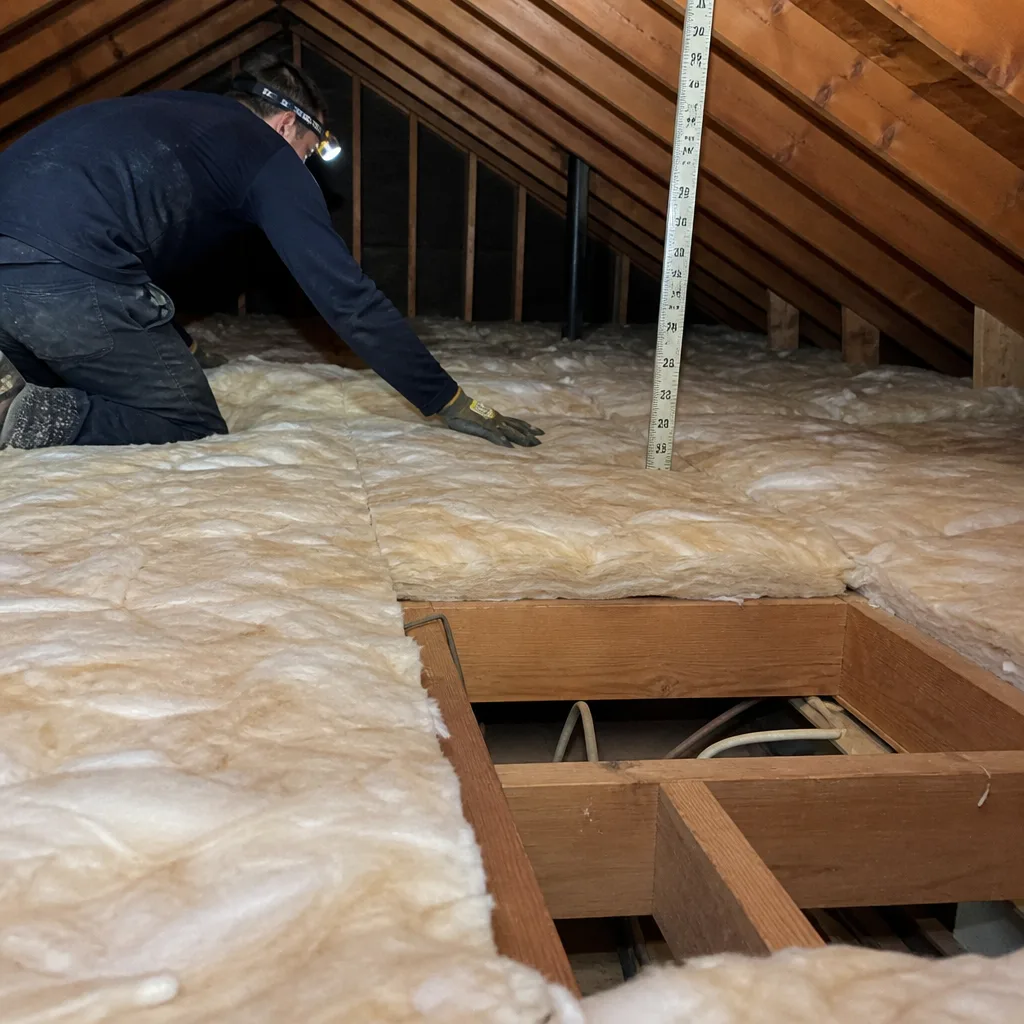
Insulation contractors in Eastvale are doing different work than what you’d find in Corona or Norco or even parts of Jurupa Valley. Eastvale’s homes are almost all 1990s-to-2010s two-story stucco tract houses with tile roofs, and the insulation problems we find here are specific to that building generation. We’re not typically drilling wall cavities in a 1950s house. We’re pulling attic hatches on 2005-era builds and finding R-13 or R-19 batts that were code-minimum when the house went up and are now performing well below their label after a decade of 140°F-plus summer attic heat. The job here is upgrading what the builder installed to the R-49 level that actually handles a Riverside County summer without the air conditioner running nonstop.
What does an attic insulation job in Eastvale actually cost? A standard attic top-up – blowing additional insulation over existing material to bring it up to R-49 – typically runs $1,200 to $2,800 depending on square footage and what’s already up there. A full attic insulation replacement, where we remove the old settled material and start fresh, lands between $2,800 and $6,000 for most Eastvale two-story homes. Adding baffles and air sealing around top plates usually adds $400 to $900. If the job includes spray foam for the garage-adjacent bonus room cavities, that pushes the upper end higher – but it’s also the most effective fix for the classic Eastvale hot-room problem.
Blown-In Upgrade Over Existing Batts
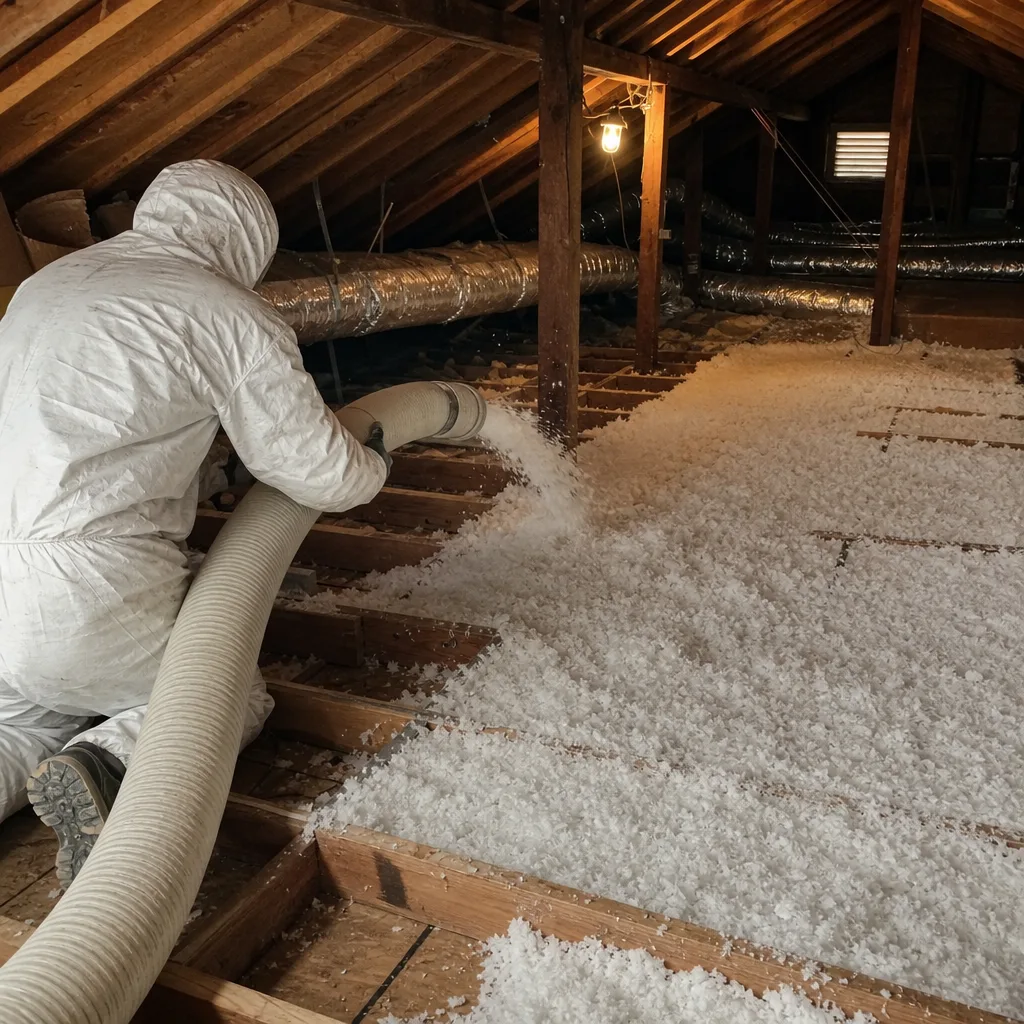
Most Eastvale attics that still have builder batts are candidates for blown-in cellulose or fiberglass over the top. The existing batts don’t necessarily need to come out – they just need to be supplemented to hit a meaningful R-value. GreenFiber blown-in cellulose is one option we use often in Eastvale because it settles into the irregular cavities that batts don’t touch and provides stronger resistance to the radiant-heat transfer that makes those bonus rooms miserable.
Attic Top-Up for Settled Material
On homes where blown fiberglass has compacted down to three or four inches above the living space, a top-up restores the R-value without the cost of a full removal. We measure what’s actually up there – not what the builder’s invoice said – and calculate the additional inches needed to reach R-49. This is the most common scope of work for Eastvale homes built between roughly 2002 and 2012.
Attic Ventilation in Eastvale
Attic ventilation in Eastvale isn’t a nice-to-have – it’s the difference between an attic that holds at 120°F and one that spikes past 145°F on an August afternoon. Most of the tract homes here were built with whatever minimum ridge or gable venting the developer specified, and it’s rarely enough once you factor in the full sun exposure on those tile roofs. A properly ventilated attic pulls cooler outside air through the soffits and exhausts the superheated air at the ridge, which does two things: it keeps the attic from cooking your insulation (heat exposure degrades R-value over time), and it reduces the heat load pressing down on your ceiling into the living space below. If you’ve already had insulation added but the upstairs still runs warm, the ventilation system is the next place to look.
Ventilation work in Eastvale generally runs $300 to $900 for soffit baffle installation and $500 to $1,500 for ridge vent or exhaust fan addition, depending on roof line and attic accessibility. If the attic is tight – common in these tract homes with low-pitch roofs – that labor goes up because the work area is cramped. We’ll give you an exact number before any work starts, so there’s no surprise on the invoice.
Soffit Baffles Before You Blow
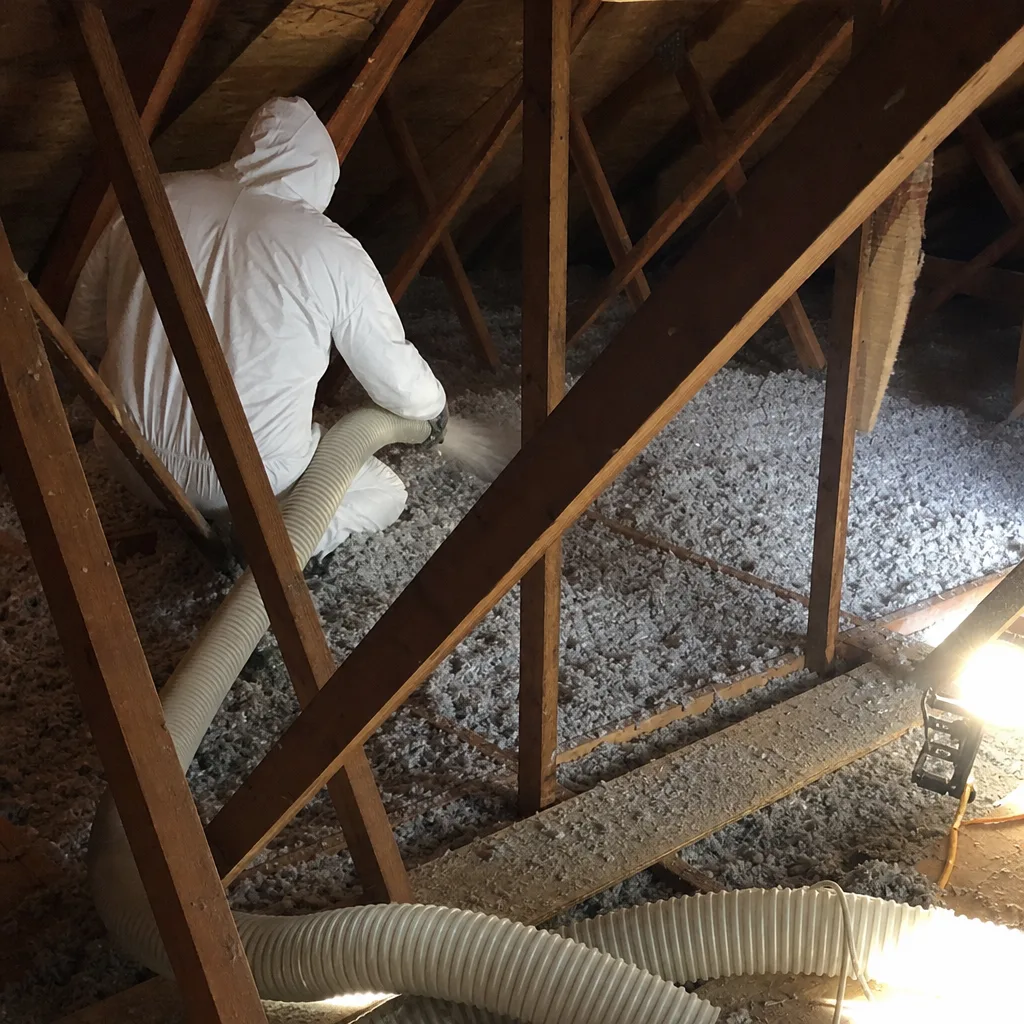
The mistake we see again and again in Eastvale is blown-in insulation added on top of soffit vents without baffles. That blocks the air intake path and turns a well-intentioned insulation upgrade into a ventilation problem. We install baffles first to protect the airflow path, then blow the insulation at full depth. It’s a small step that prevents the whole system from underperforming.
Ridge Vents and Exhaust for Tile Roofs
Eastvale’s tile roofs hold heat differently than composition shingle roofs, and the venting strategy has to account for that. A ridge vent along the peak gives the superheated air a natural escape path, and when paired with the right soffit intake, it can drop attic temperatures by a measurable margin. On homes where the roof design doesn’t allow for continuous ridge venting, we look at powered exhaust options that move enough air to make a real difference.
Trusted Brands We Service in Eastvale
We stock and install from a material library that covers eight industry-leading brands, and that breadth matters for Eastvale homeowners because no single product solves every attic problem. CertainTeed fiberglass works well for standard ceiling cavities. GreenFiber blown-in cellulose is our go-to for topping up settled material over bonus rooms. When a client wants mineral wool from Rockwool for fire resistance and sound dampening alongside thermal performance, we can do that too. For Eastvale homeowners who need spray foam – especially closed-cell Demilec or Icynene in the hard-to-reach cavities around open two-story foyers – we have both chemistries available and we’ll choose based on the application. Most insulation companies carry one or two product lines. We carry eight, so your home gets what it actually needs, not what someone’s supplier happens to stock that week.
Common Attic Insulation Problems We See in Eastvale Homes
- Builder-grade R-13/R-19 batts that have stopped performing. A decade of 140°F attic heat breaks down fiberglass batts’ ability to resist heat transfer. They look fine from the hatch. They’re not.
- Settled or missing insulation over garage-adjacent bonus rooms. This is the first thing our techs check on every Eastvale two-story. We’ve found bonus room ceilings with barely three inches of blown material while the main field reads R-19.
- Unsealed top plates and soffit gaps channeling hot attic air into living space. Open two-story foyers and irregular bonus room framing create air pathways the builder never sealed. Hot air doesn’t wait for an invitation.
- Attached garages that bake in afternoon sun and radiate heat upward. The garage ceiling is rarely insulated to the same level as the living space above it, and in Eastvale’s tract layouts, that garage sits directly under a room you actually use.
Pricing for Attic Insulation in Eastvale, CA
In Eastvale, attic insulation pricing breaks down more predictably than in older cities because the housing stock is so uniform. A standard attic top-up in Eastvale runs $1,200 to $2,800. Full replacement of settled or degraded insulation runs $2,800 to $6,000 for a typical 5280-era two-story. Adding baffles and air sealing runs $400 to $900. Closed-cell spray foam for bonus room or garage ceiling cavities runs $2,000 to $4,500 depending on the size of the irregular space being treated. The biggest cost drivers are square footage, existing insulation depth, and how hard your attic is to access – some Eastvale tracts have low-pitch roofs that make movement slow. Call (855) 773-6429 for an exact quote. Estimates are free, and you’ll get a number from someone who has already worked in your neighborhood, not a call center reading from a price sheet.
We Also Serve Cities Near Eastvale
Our work in Eastvale keeps us traveling the same roads that connect Norco, Home Gardens, Corona, and Jurupa Valley, so if you’re in a neighboring city and dealing with the same builder-grade attic problems, we can help. Same team, same material library, same straight answers.
Serving Eastvale, CA — Our Local Coverage Area
We’re based in the Eastvale area and know this community well. Use the map below to see our service coverage — if you’re nearby, we can almost certainly help.
FAQs About Attic Insulation in Eastvale
The bonus room above your attached garage is baking because the insulation over that specific ceiling cavity is either too thin, settled down to a fraction of its original depth, or missing entirely. Builders in Eastvale’s post-1990s tracts often skimped on insulation above garages because it’s not technically living space below, but the room above it absolutely is. On a 5280-era two-story in Eastvale, our tech opened the attic hatch and found the blown fiberglass over the garage-adjacent bonus room settled to barely three inches while the main field sat at builder R-19 – that bonus room was baking by 3pm every summer day. We air-sealed the top plates, baffled the soffits, and blew GreenFiber up to R-49 over the bonus room and attached garage line, then added a ridge vent to bring the 140°F-plus afternoon attic temps down. The process takes a day in most Eastvale two-stories and solves the hot-room problem permanently. Call (855) 773-6429 for an assessment – we’ll tell you exactly what’s above that bonus room.
For Eastvale’s hot-dry climate, an attic ceiling should carry R-49 to meaningfully cut heat gain into living space. Builders installed R-13 to R-19 when these tract homes went up because that met code at the time. Code minimum was never designed for comfort during Inland Empire summer peaks, and after years of thermal breakdown, the actual effective R-value is lower than the label suggests. R-49 is the standard we recommend for every Eastvale attic we touch – it’s the level where you start to feel the difference in upstairs room temperature and see it reflected in the July and August electric bill.
No, in most Eastvale homes the existing insulation stays in place and we blow new material over the top to reach R-49. Removal only makes sense if the old material is water-damaged, pest-contaminated, or so compressed that it’s trapping moisture against the drywall. Our techs assess the condition through the attic hatch and show you what they’re seeing. For the vast majority of Eastvale tract homes, a top-up is the right call and it keeps the total project cost down.
Yes, and it’s the most direct lever you can pull for summer utility costs here. When attic temperatures drop from 140°F-plus down to something closer to the outside air temperature, the ceiling stops radiating heat into your living space, which means your AC isn’t fighting an uphill battle all afternoon. Eastvale homeowners who combine insulation upgrades with proper ventilation typically see cooling bill reductions in the meaningful double-digit percentage range during summer months, with the upstairs becoming genuinely comfortable for the first time. The exact savings depend on your current insulation depth, window condition, and AC efficiency, but the physics is consistent: less heat above your ceiling means less cooling load below it.
A standard top-up or replacement on an Eastvale two-story takes one to two days from opening the attic hatch to final cleanup. Attic baffles and air sealing add a half day. Closed-cell spray foam work on bonus room cavities or foyer spaces can add another day depending on the number of irregular spaces being treated. Most Eastvale jobs wrap inside two days, and we schedule around your availability so you’re not taking time off work to meet us. We’ll give you a firm timeline when we provide the estimate.
Get Your Eastvale Attic Assessed
If your upstairs rooms are hot, your summer bills are climbing, or you already know what’s above your bonus room and it isn’t enough, call Placentia Insulation at (855) 773-6429. We’ll send a technician who works exclusively on insulation, knows exactly what to look for in Eastvale’s master-planned tracts, and will give you a straight answer and a firm price. Free estimates, no pressure, no generalists guessing at your attic.
Written by Alan Whitcomb, Owner at Placentia Insulation, serving Eastvale, CA and the surrounding Inland Empire communities.