
Fast, Reliable Spray Foam Insulation Across Rialto
Spray foam insulation in Rialto costs $2.50 to $6.50 per board foot for open-cell and $3.75 to $9.00 per board foot for closed-cell, with a typical 1,000-square-foot attic running $3,800 to $8,200 all-in. That’s the honest range before we see your attic. Our crews work throughout Rialto weekly, from the older tract neighborhoods in 92376 to the newer foothills homes in 92377, and we know what these attics look like before we even lift the hatch. If you’re fighting a hot upstairs, a garage that bakes in the afternoon, or dust blowing in every time the Santa Anas pick up, call (855) 773-6429 for a free assessment. We’ll tell you what you actually need, not what’s easiest to sell.
The real difference in Rialto isn’t just the foam. It’s knowing what’s already up there: 60-year-old batts that have settled to nothing, ductwork sweating in a 150°F attic, and air leaks from decades of electrical and HVAC work that no amount of R-value will fix on its own. We match the material to the job, not the job to whatever we have on the truck.
Why Placentia Insulation Is Rialto’s Preferred Spray Foam Insulation Company
Most insulation contractors carry one or two product lines. We carry eight: Owens Corning, Johns Manville, Knauf, Rockwool, CertainTeed, Icynene, Demilec, and GreenFiber. For spray foam specifically, that means both Icynene open-cell and Demilec closed-cell are options we can actually put in your Rialto home, depending on what the attic calls for. Single-brand shops can only sell you what they stock. We can pick the chemistry that matches your roof deck, your budget, and the way your house breathes.
We’re insulation-only. Every crew member, every tool, every conversation is about one trade. When we send a team to a home near Rialto Avenue or up toward the 92377 foothills, they’re not thinking about a plumbing job next week. They’re thinking about your top plates, your rim joists, your attic hatch, and the air moving through your walls. That focus is why Rialto homeowners keep calling us back when they buy a second property or finally tackle the garage.
Alan Whitcomb leads our operation, and he’s spent his career in this trade. The kind of detail we bring to a 1960s Rialto tract home – inspecting what’s already there, air-sealing before we spray, checking the duct runs – comes from doing insulation work every single day, not as a side service bolted onto a general contracting business.
Garage Spray Foam Insulation in Rialto
Garage Spray Foam Insulation in Rialto is one of the most common projects we quote in 92376, where attached garages on mid-century tract homes act like ovens that radiate heat into the living space through the shared wall and ceiling. In Rialto’s summer, a garage ceiling without insulation can reach 130°F on the underside by mid-afternoon, turning the room above it into the hottest bedroom in the house even with the AC running. We spray closed-cell foam directly onto the garage ceiling or the rim joist and band board area, sealing the air path between the garage and the conditioned space above.
Rialto homeowners typically call us about garage ceiling foam when the bedroom over the garage is 8 to 12 degrees hotter than the rest of the house, or when car exhaust smells filter into the living space. The fix usually runs $1,400 to $3,200 for a two-car garage ceiling in Rialto, depending on whether we’re foaming just the ceiling or also the shared wall and rim joists.
Where the heat actually gets in
The garage wall that connects to your house is the biggest culprit. In 1960s Rialto builds, that wall often has no insulation at all – just drywall on 2×4 studs with an air gap that lets heat and fumes move freely. We treat that wall as a thermal boundary and seal it with closed-cell foam, which changes how the whole hallway or bedroom above feels within a day.
What we find in Rialto garages
The second thing we fix is the garage ceiling/roof line, especially where a flat truss roof leaves a shallow cavity that fiberglass never worked well in. Closed-cell foam at two inches delivers about R-13 plus an air seal in that tight space, where batts would sag, compress, and leave gaps. For homes with bedrooms directly above the garage, this upgrade is routinely the difference between a room you avoid in August and one that holds temperature. In fact, our Spray Foam Insulation team has fixed more Rialto garage-ceiling complaints than we can count, and the root cause is almost always unsealed air, not just missing R-value.
Closed Cell Spray Foam Insulation in Rialto
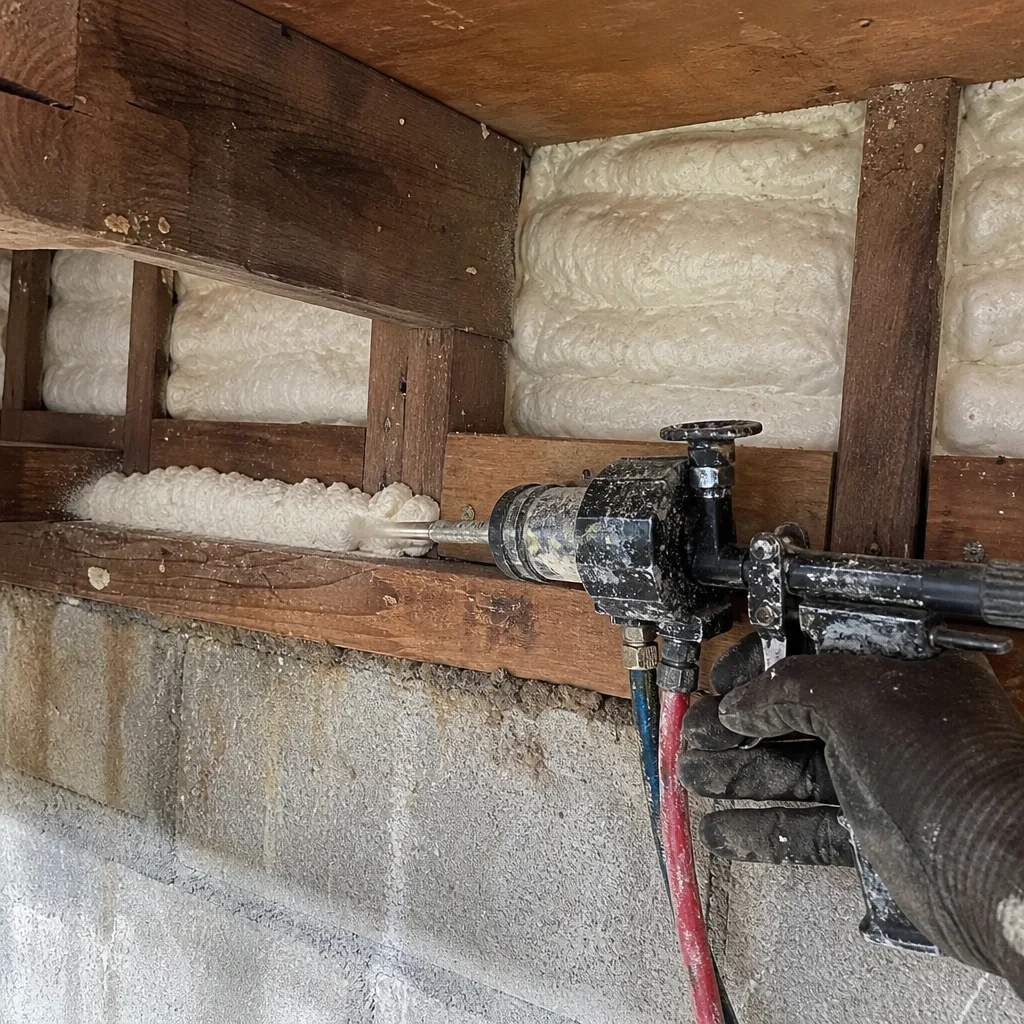
Closed Cell Spray Foam Insulation in Rialto is the workhorse for older attics where air movement is the real problem, not just heat. In a 1950s or 60s tract home with original fiberglass batts that have settled to R-11 or less, adding blown-in insulation on top without sealing the ceiling plane just traps heat and moisture against the roof deck. Closed-cell foam at 1.5 to 2 inches air-seals the top plates, penetrations, and seams while adding R-7 per inch in structure.
Closed cell costs more per board foot in Rialto – typically $1.15 to $1.45 per board foot per inch of thickness – but it’s not the same product as open-cell. It forms a rigid, vapor-resistant barrier that adds structural strength and blocks air movement. For Rialto attics where the ductwork lives, closed-cell is often the only material that stops the 150-degree air from cooking the ducts while the AC is trying to push 55-degree air through them.
Hot attic, leaky ducts
If you see condensation on your duct boots in a Rialto summer, your attic is winning. Closed-cell foam on the attic deck and gable ends brings that air temp down by 20 to 30 degrees on a 105°F afternoon, which directly extends the life of your ductwork and cuts the load on your AC. We won’t spray foam over a dirty, disturbed attic without air-sealing first.
Why 2 inches beats 6 inches sometimes
In a very tight Rialto attic with knee walls and shallow rafter bays, two inches of closed-cell foam does more than six inches of fiberglass ever could because it stops convection. The R-value isn’t the whole story. The air seal is. We’ve sprayed closed-cell in 92376 homes where the customer had previously paid for blown-in fiberglass, and their complaint was “it didn’t help.” That’s because the air moving through the ceiling was bypassing all the fluffy stuff. Foam seals it. That’s the material science, and it’s why we don’t just sell the thickest bill of goods.
Trusted Brands We Service in Rialto
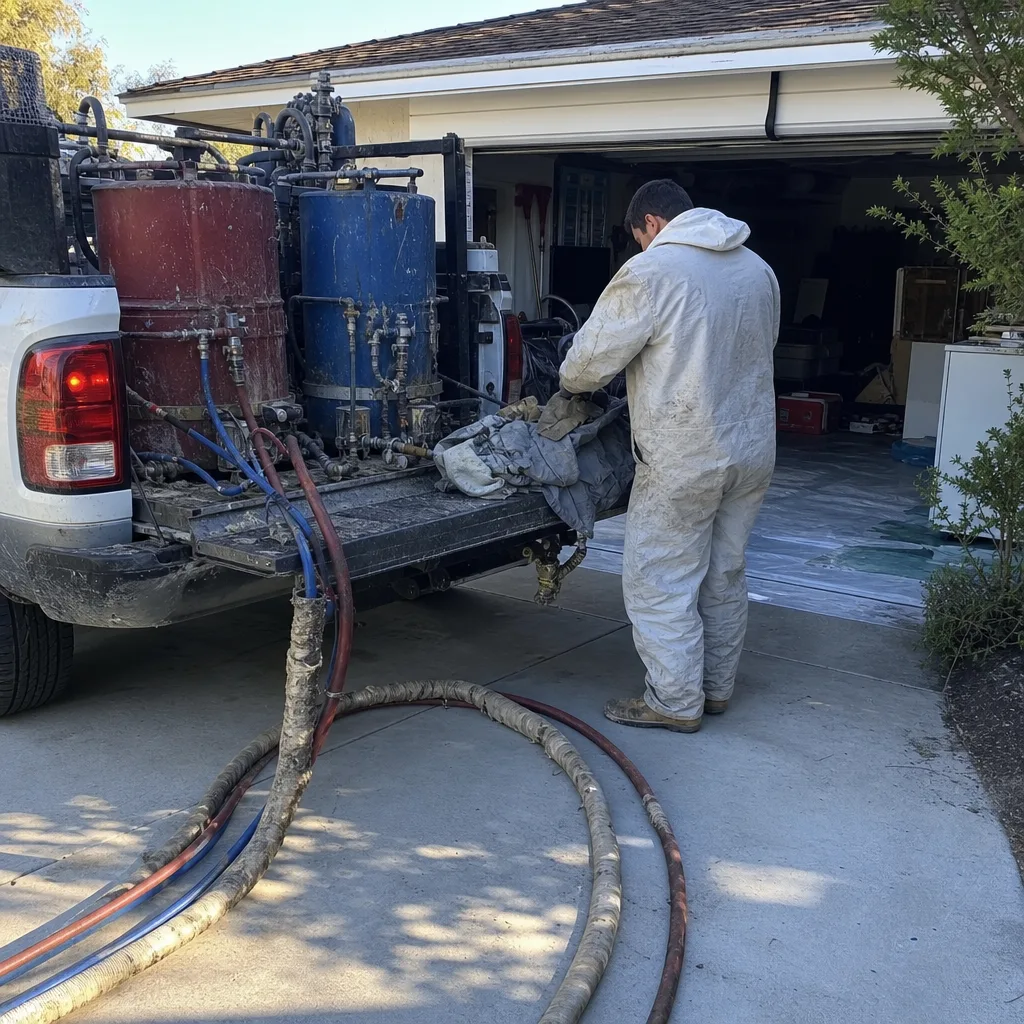
Placentia Insulation installs Icynene open-cell and Demilec closed-cell spray foam, and we stock the hoses, tips, and chemical drums required to keep a Rialto project moving without waiting on a distributor in Riverside or Ontario. For homeowners who don’t need spray foam, we also install CertainTeed fiberglass and GreenFiber blown-in cellulose. But for the Rialto jobs we’re talking about here – attics that leak air like a screen door – the Icynene and Demilec options are what make the difference. We know the cure windows, the temperature limits, and the pass thickness for each product, which matters when spraying in 140°F attics in August. We don’t guess with material chemistry. That’s not a guess you make in someone’s home.
Common Spray Foam Insulation Problems We See in Rialto Homes
- Foam sprayed over disturbed fiberglass without air-sealing first. We regularly find 92376 attics where a previous contractor sprayed foam directly over compressed, settled batts and expected it to work. The foam sealed the surface, but the air path underneath remained intact. Heat and moisture still move through the framing, the R-value gain is wasted, and the roof deck traps whatever was already up there. The fix is to remove or isolate the bad fiberglass, seal the ceiling plane, and then apply foam to the right surface.
- Closed-cell foam in 92377 stucco homes that never addressed leaky ducts. Newer homes up near the foothills get the same treatment: spray the roof deck, leave the ducts. But on a 100°F day, uninsulated duct runs in those attics lose a third of the cooling before the air reaches a bedroom. We see this in 1980s and 1990s stucco builds in 92377 constantly. The correct sequence is seal the ducts first, or at minimum foam the duct runs while the attic is open.
- Off-gassing and poor adhesion when spraying in extreme Rialto summer heat. Demilec and Icynene both specify substrate and ambient temperature limits. A 140°F roof deck in August is right at the edge of those limits. Untrained crews spray anyway and get shrinkage, poor cure, and an attic that smells for weeks. We schedule summer Rialto work early in the morning and adjust pass thickness to the heat. It’s a materials discipline that matters in the Inland Empire.
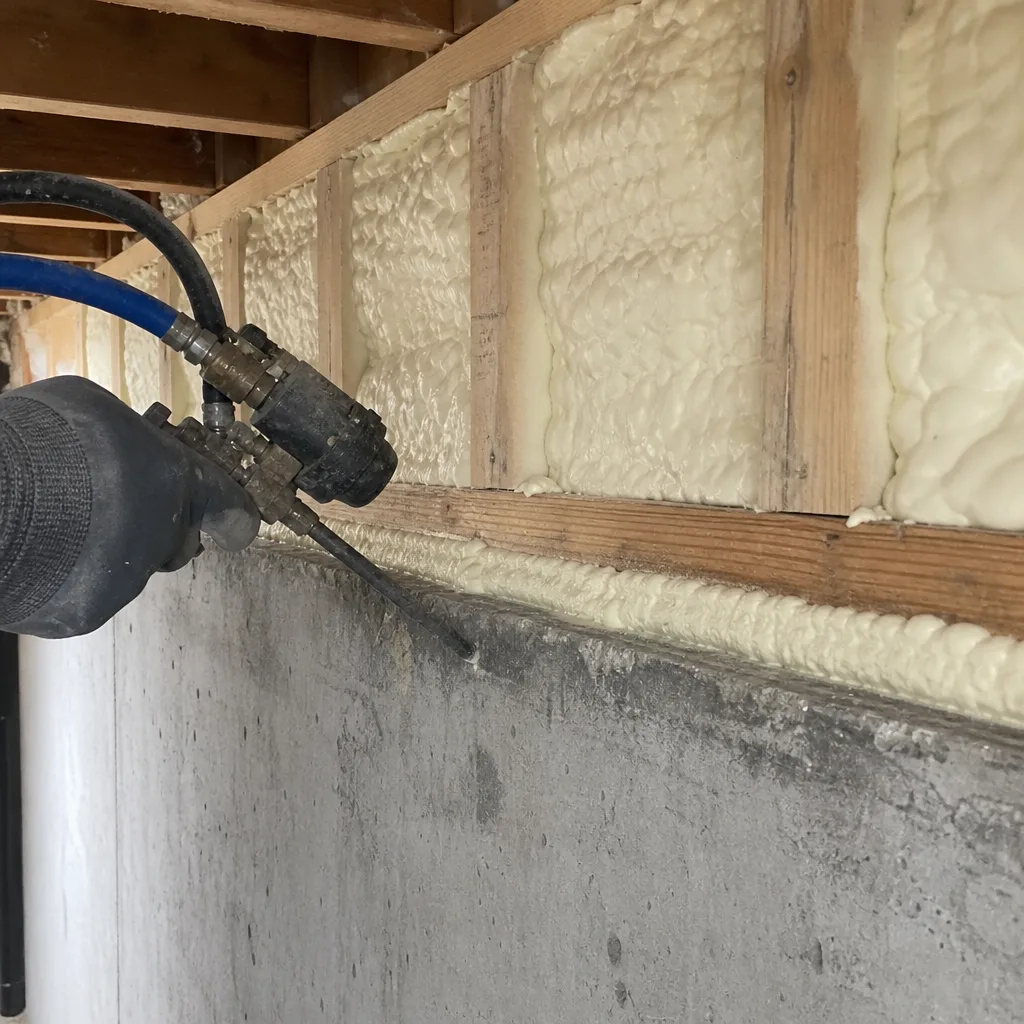
- Ignoring the rim joist in Rialto homes with crawl spaces or raised foundations. Many 1950s Rialto homes have pier-and-beam or raised floor sections. Air moves up from the crawl space through the rim joist and into the walls. Homeowners insulate the attic and wonder why the house still drafts. Sealing the rim joist with 2 inches of closed-cell foam stops that chimney effect at the bottom of the wall assembly.
Pricing for Spray Foam Insulation in Rialto, CA
A typical open-cell attic spray in Rialto runs $4,200 to $6,800 for 1,000 to 1,400 square feet, including prep, air-sealing, and cleanup. Closed-cell on the same attic runs $6,500 to $9,500 because the material cost is roughly double and the application is more exacting. Garage ceilings are smaller jobs, usually $1,400 to $3,200. Rim joist sealing in a Rialto crawl space runs $900 to $2,100. The biggest cost driver isn’t the square footage – it’s the condition of what’s already up there. If we have to remove or isolate failed fiberglass, repair drywall, or rework duct connections first, that adds labor. We give you the number before we start, and the estimate is free. Call (855) 773-6429 and we’ll walk the attic with you and show you exactly what we’d do.
We Also Serve Cities Near Rialto
Our crews cover the full Rialto area and regularly work in Bloomington, Fontana, Muscoy, and San Bernardino. If you’re just across the city line in one of those communities, the same team and the same pricing apply. We schedule by route, so a Rialto project and a Bloomington project often share the same week.
Serving Rialto, CA — Our Local Coverage Area
We’re based in the Rialto area and know this community well. Use the map below to see our service coverage — if you’re nearby, we can almost certainly help.
FAQs About Spray Foam Insulation in Rialto
Because your 1960s Rialto home’s problem is air movement, not just missing R-value. The original batts in those houses have settled to R-7 or R-11, and adding blown-in insulation on top doesn’t seal the top plates, wire penetrations, or duct chases. In a 92376 attic, hot air moves through those gaps at 150°F in summer, bypassing whatever fluffy material you add. Closed-cell spray foam seals those air paths and adds R-value in the same pass. That’s the difference between a fix that works and one that just costs money. If you want a real answer about your specific attic, call (855) 773-6429 and we’ll inspect it for free.
Yes, and we do it frequently in both 92376 and 92377. A garage ceiling in a Rialto home without insulation reaches 130°F by mid-afternoon in July, and that heat moves straight through the shared wall into the living space. We spray 2 inches of closed-cell foam on the garage ceiling or the shared wall cavity, which seals the air path and stops the heat transfer. Most Rialto garage ceiling jobs are done in one day. Call (855) 773-6429 for a garage-specific quote.
The Cajon Pass wind drives fine dust and outdoor air into Rialto attics through every vent, soffit, and unsealed seam. During spray foam installation, that moving air makes it harder to achieve a clean seal around penetrations and top plates. Our crews check wind conditions before spraying and often seal the windward side of the attic first. The result is a tighter attic that doesn’t pull dust into the house every time the Santa Anas blow. The wind is also a reason closed-cell beats fiberglass in Rialto: it can’t be displaced by moving air the way loose fill can.
Yes, closed-cell spray foam is routinely applied in older Rialto homes with original wiring, but the wiring must be assessed and properly protected first. Foam is a nonconductive material, and the application process happens around the wiring, not over live connections or damaged conductors. If your 1962 home still has cloth-wrapped or degraded wiring, that’s a safety issue we’ll flag before we spray. We’ve done hundreds of legacy 92376 attics, and the sequence is always the same: inspect first, seal second, foam third. No exceptions.
A 92376 attic with settled R-11 batts typically goes to R-30 to R-38 after we remove or isolate the old material, air-seal the ceiling plane, and apply 5 to 6 inches of open-cell or 2 to 3 inches of closed-cell foam. The real-world performance gain is higher than the R-value math suggests because you’re also stopping air movement for the first time since the house was built. Homeowners routinely tell us the upstairs finally holds temperature in August. Call (855) 773-6429 for a specific recommendation on your attic.
Get Your Rialto Spray Foam Quote
If your Rialto attic is baking through another Inland Empire summer, don’t keep feeding the problem with higher AC bills. We inspect attics in 92376 and 92377 every week, and we’ll give you an honest recommendation: where it needs air-sealing, what R-value you need, and whether open-cell or closed-cell makes sense. Placentia Insulation is insulation-only, brand-diverse, and led by Alan Whitcomb. Call (855) 773-6429 today and we’ll come out, look at what you’ve got, and show you exactly what we’d do. The estimate is free, and you’ll know more about your attic in 30 minutes than you did in 30 years.
Written by Alan Whitcomb, Owner at Placentia Insulation, serving Rialto and the Inland Empire.