
Fast, Reliable Spray Foam Insulation Across Valley Glen
Spray foam insulation in Valley Glen typically costs $2.80 to $6.50 per board foot installed, with most whole-attic jobs landing between $4,200 and $8,900 depending on thickness and whether we’re doing open-cell or closed-cell. We run crews into Valley Glen every week, and most jobs are scheduled within 5 to 7 business days. If you’re in 91404 and your attic turns into an oven by noon, call (855) 773-6429 and we’ll walk you through what your home actually needs, not what’s easiest to install.
Valley Glen’s housing stock is specific. You’ve got single-story ranch and tract homes built in the 1950s and 60s, most of them with original fiberglass batts that were undersized even when they went in. Sixty years of San Fernando Valley summers have compressed those batts, settled the blown-in material, and left gaps around every ceiling penetration. We know what we’re going to find before we climb the ladder. That’s the difference between a company that works in Valley Glen regularly and one that’s driving over the hill for the first time.
Why Placentia Insulation Is Valley Glen’s Preferred Spray Foam Insulation Company
We’re an insulation-only contractor. That’s not a tagline; it’s how we’re built. Every crew member we send to Valley Glen works on insulation every single day. Not plumbing. Not HVAC. Not “whatever the truck has room for.” When we pull up to a home near Valley Glen Community Park or off Burbank Boulevard, the conversation starts with your building envelope and stays there.
Alan Whitcomb runs our crews, and he’s particular about one thing: matching the foam chemistry to the application. A roof deck near the Tujunga Wash that hits 150°F by midday needs closed-cell foam specified for high-heat cycling. A garage ceiling that separates a hot box from your laundry room needs a different approach than a crawl space rim joist. Most insulation contractors carry one or two product lines. We carry eight, including Icynene and Demilec for spray foam. So your Valley Glen home gets what it actually needs, not whatever’s on the truck.
Our Spray Foam Insulation team has handled hundreds of mid-century ranch homes across the San Fernando Valley, and Valley Glen’s tract-built stock is among the most predictable, and most rewarding, to retrofit. The framing is straightforward. The attics are accessible. The problems are consistent. And when we air-seal and foam a home that’s been leaking conditioned air for five decades, the difference in comfort is immediate.
Garage Spray Foam Insulation in Valley Glen
Garage Spray Foam Insulation in Valley Glen is one of the most common retrofit jobs we handle, and for good reason. Those single-story ranch homes from the 1950s and 60s almost always have an attached garage with no insulation at all. The garage ceiling bakes in the Valley sun, the air inside hits 120°F by early afternoon, and that heat bleeds straight through the shared wall into your kitchen or den. Foaming the garage ceiling and the shared wall with closed-cell spray foam cuts that transfer dramatically. A typical garage ceiling job in Valley Glen runs $1,800 to $3,600 depending on square footage and whether we’re also doing the wall cavity.
Shared Wall Treatment
When your garage shares a wall with living space, closed-cell foam in that wall cavity does two jobs at once. It stops the heat, and it gives the wall a vapor barrier without adding a separate layer. For Valley Glen homeowners who’ve added a laundry room or pantry against the garage, this is usually the first fix we recommend.
Ceiling Air Seal
Before foam goes on the garage ceiling, we seal every penetration: electrical boxes, plumbing drops, and the gaps where trusses meet the top plate. Spraying foam over unsealed penetrations just hides the air leak. In a 1960s Valley Glen tract home, there will be penetrations you didn’t know existed.
Closed Cell Spray Foam Insulation in Valley Glen
Closed Cell Spray Foam Insulation in Valley Glen is the right call for any surface exposed to the Valley’s extreme heat cycling. Closed-cell runs about $1.75 to $2.50 per board foot more than open-cell, but it delivers roughly R-6.5 per inch, adds structural rigidity, and acts as a vapor barrier. For roof decks in Valley Glen, where 150°F attics are common near the Tujunga Wash, closed-cell is the only foam we’ll specify without a conversation about open-cell alternatives. A typical 1,200-square-foot attic roof deck in Valley Glen runs $4,500 to $7,200.
Roof Deck Application
Foaming the roofline itself, rather than the attic floor, turns the attic into conditioned space. That matters in Valley Glen. When your HVAC equipment and ductwork live in that attic, they’re currently sitting in a 140°F box every summer afternoon. Closed-cell foam on the roof deck drops that temperature by 25 to 35°F, which means your AC isn’t fighting itself.
Rim Joist Sealing
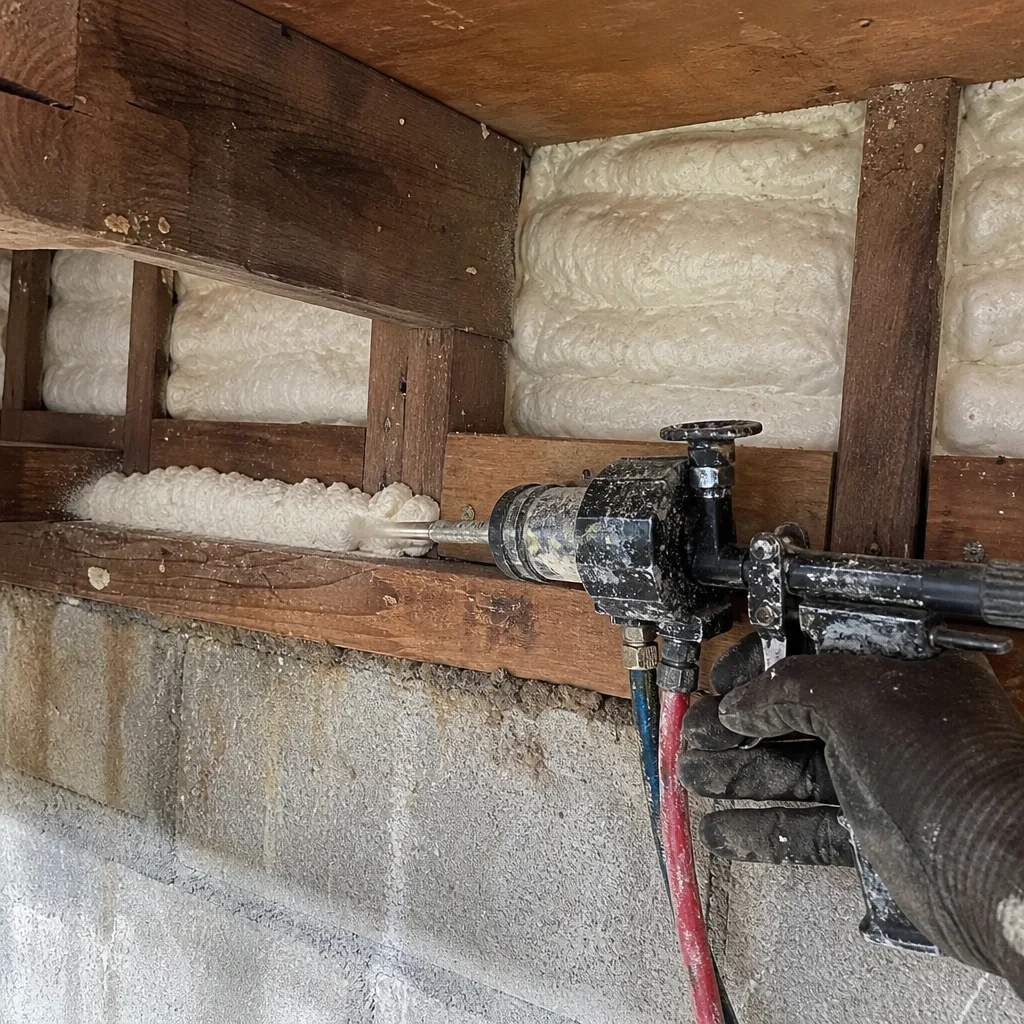
The rim joist, the band of framing where your foundation meets your floor system, is a major air leak in every Valley Glen home. Closed-cell foam applied to rim joists seals air, adds R-value, and keeps moisture from condensing on the wood. It’s a one-trip job we often bundle with attic work.
Trusted Brands We Service in Valley Glen
We install Icynene and Demilec spray foam systems because they’re the two most proven chemistries in the category. Icynene open-cell is our go-to for tight attic cavities and interior walls in Valley Glen homes, where the foam needs to expand into every odd corner of a 60-year-old framing system. Demilec closed-cell is what we specify for roof decks, garage ceilings, and anywhere vapor drive is a concern. For homeowners who want a cellulose option somewhere in the house, we stock GreenFiber through our blown-in division. We don’t try to sell one brand. We match the material to the job, and we’ll explain exactly why a particular foam belongs on a particular surface.
Common Spray Foam Insulation Problems We See in Valley Glen Homes
- Foam applied over settled fiberglass. When a contractor sprays foam directly on top of compressed, dusty fiberglass batts, the foam never bonds to the drywall or sheathing. It traps heat in the old material and starts delaminating within a few years. In Valley Glen homes, we remove the old material first, every time.
- Inadequate roof deck thickness near the Tujunga Wash. Homes on the wash side of Valley Glen see attic temperatures that stay at 140°F to 150°F for hours. One inch of closed-cell foam, roughly R-6.5, is not enough to change that thermal profile. We specify 2 inches minimum on roof decks in that microclimate.
- Poor adhesion to 1950s sheathing. Original plywood and shiplap in Valley Glen tract homes has 60 years of dust, sometimes oil from old furnaces, and the occasional roof leak stain. Foam needs clean, dry substrate to bond. We prep the surface, or we don’t spray.
- Ignored rim joists and air bypasses. A perfect attic foam job won’t fix comfort if the rim joists leak air at the foundation line and every electrical chase runs open from crawl space to attic. Valley Glen ranch homes are full of these bypasses. We check them as part of every spray foam estimate.
Pricing for Spray Foam Insulation in Valley Glen, CA
Here are straight numbers for Valley Glen’s market. Open-cell spray foam runs $0.45 to $0.75 per board foot for material, with installed costs typically $1.10 to $1.65 per board foot. Closed-cell runs $1.20 to $1.80 per board foot material, $2.75 to $3.50 installed. A full attic floor in a 1,400-square-foot Valley Glen ranch is usually $3,800 to $5,900. A roof deck job on the same home runs $4,500 to $7,200. Garage ceilings are $1,800 to $3,600. What moves the price up: prep work on old material, access issues in low-slope roofs, and added thickness for the Tujunga Wash heat load. Estimates are free. Call (855) 773-6429 and we’ll give you exact numbers for your house.
We Also Serve Cities Near Valley Glen
Placentia Insulation runs crews throughout the San Fernando Valley, including Spray Foam Insulation in Valley Glen and the surrounding communities. We’re regularly on site in Van Nuys, Sherman Oaks, Encino, and North Hills. If you’re just outside the 91404 ZIP and wondering whether we cover your street, call and ask. We probably do.
Serving Valley Glen, CA — Our Local Coverage Area
We’re based in the Valley Glen area and know this community well. Use the map below to see our service coverage — if you’re nearby, we can almost certainly help.
FAQs About Spray Foam Insulation in Valley Glen
Valley Glen’s housing stock drives cost more than geography does. The prep work is heavier: removing settled fiberglass from 1950s and 60s attics, air-sealing penetrations that have been open for six decades, and specifying thicker closed-cell on roof decks near the Tujunga Wash. You’re not paying a Valley Glen premium; you’re paying for the retrofit conditions that Valley Glen homes actually have. Most other parts of LA see the same pricing once the scope is identical. Call (855) 773-6429 for a line-item estimate on your specific house.
Yes, and it’s the single most effective retrofit for heat rejection in a Valley Glen home. Closed-cell foam on the roof deck drops peak attic temperature by 25 to 35°F, which means your HVAC isn’t pulling hot air from a 150°F attic into the living space. We’ve seen it stop short-cycling within a day of install.
On a detached garage, we usually foam the ceiling plane and the walls. For a structure that’s not conditioned, open-cell foam at 2 to 3 inches is often enough to knock 40°F off the interior temperature in summer. If the garage is a workshop or you’re running equipment in there, we’ll step up to closed-cell for the vapor barrier and added durability. You still need ventilation if you’re parking cars or storing gasoline, and we’ll factor that into the spec.
Two inches of closed-cell foam, roughly R-13, is the minimum we recommend for roof decks on the wash side of Valley Glen. That’s more than we’d spec for a home in a tree-covered pocket of Encino. The Wash side gets full solar bake with little tree canopy, and attic temperatures hold at 140°F to 150°F for hours. Two inches of closed-cell with proper air sealing changes that thermal profile enough to matter.
If the old insulation is fiberglass batts, yes, we remove them before spraying. Batts leave gaps, they settle, and they prevent foam from bonding to the surface. If the old insulation is blown-in cellulose or fiberglass on an attic floor, we remove it if it’s damp, rodent-soiled, or compressed below its rated R-value. Spraying over settled blown-in material defeats the purpose of doing the job at all.
Ready to talk specifics about your Valley Glen home? Call (855) 773-6429 for a free attic assessment and a line-item quote. We’ll tell you what we’d do, why we’d use the foam we recommend, and what it’ll cost. No pressure, no vague promises, just a clear plan from an insulation specialist.
Written by Alan Whitcomb, Owner at Placentia Insulation, serving Valley Glen and the San Fernando Valley.