
Fast, Reliable Spray Foam Insulation Across Home Gardens
Spray foam insulation in Home Gardens runs roughly $1,800 to $4,200 for a typical attic and $2,900 to $6,500 for a detached workshop, depending on square footage, foam chemistry, and how much prep the existing framing needs. We’re out to Home Gardens regularly from Placentia, and most jobs on Ontario Avenue or the side streets off Magnolia get a same-week start. If you’re fighting a hot second floor in July or a workshop that bakes through the afternoon, call (855) 773-6429 and we’ll walk through what your specific structure actually needs.
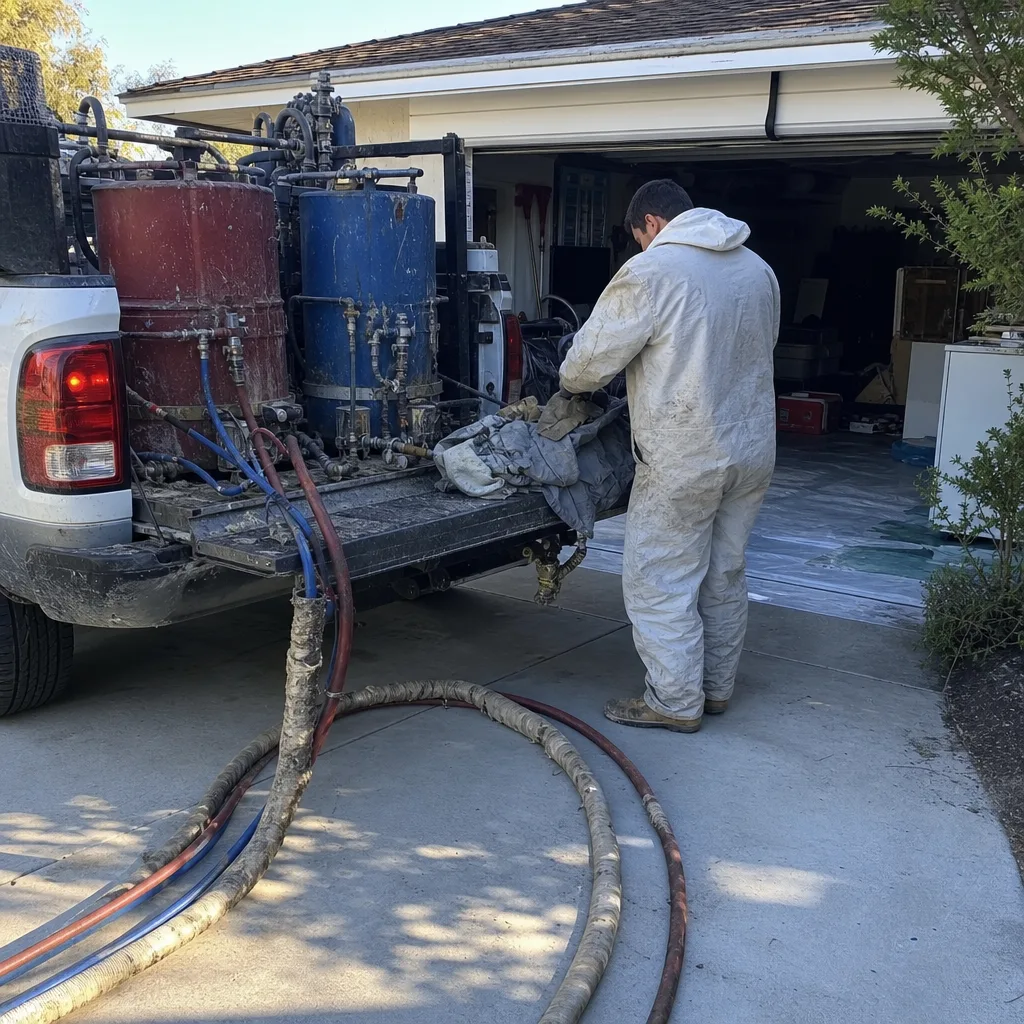
This is not a one-material-fits-all situation. We stock open-cell Icynene for interior attic decks and tight framing, closed-cell Demilec for rim joists and areas where moisture or structural reinforcement matters, and GreenFiber blown-in for places where spray foam isn’t the right call. We match the material to the job, not the job to whatever we have on the truck.
Why Placentia Insulation Knows Home Gardens Spray Foam Work
Home Gardens is its own weird and wonderful jurisdiction. It’s an unincorporated Riverside County island sitting there while Corona wraps around it. That means the permitting path, the inspection sequence, and the building history of each property often differ from what a Corona or Norco homeowner deals with. Alan Whitcomb, our owner, has spent enough time on Home Gardens lots to know that a 1950s ranch on Ontario Avenue almost never has the same attic assembly as the house two doors down.
That’s not a problem for us. It’s the job. We’re an insulation-only company, so every crew that rolls into 92879 is running foam, fiberglass, mineral wool, or cellulose that day. Nobody is splitting attention between your attic and somebody else’s plumbing. Home Gardens homeowners call us because their attic was built in 1962, added on to in 1988, re-roofed in 2005, and nobody ever updated the venting. We find what’s actually up there and work from that. Estimates are free. Call (855) 773-6429 and we’ll come look.
Open Cell Spray Foam in Home Gardens
Open Cell Spray Foam in Home Gardens is the go-to material for the undersides of roof decks and the irregular, owner-built attics we see constantly in the Ontario Avenue stretch. It expands roughly 100 times its liquid volume and fills odd cavities, nail gaps, and junctures where 60-year-old framing meets 40-year-old additions. The material itself stays vapor-permeable, which means moisture can still dry through it. That matters in Home Gardens because so many attics here never got a venting update when the roofline changed, and a material that traps moisture in that scenario is a slow disaster.
Typical open-cell projects in Home Gardens land between $1,800 and $4,200 for a main attic. A detached workshop with a gable roof runs smaller, usually $1,200 to $2,800 depending on deck area. You’re paying for material application, air-sealing prep, and the venting check that the structure probably never received.
Where Open-Cell Belongs Here
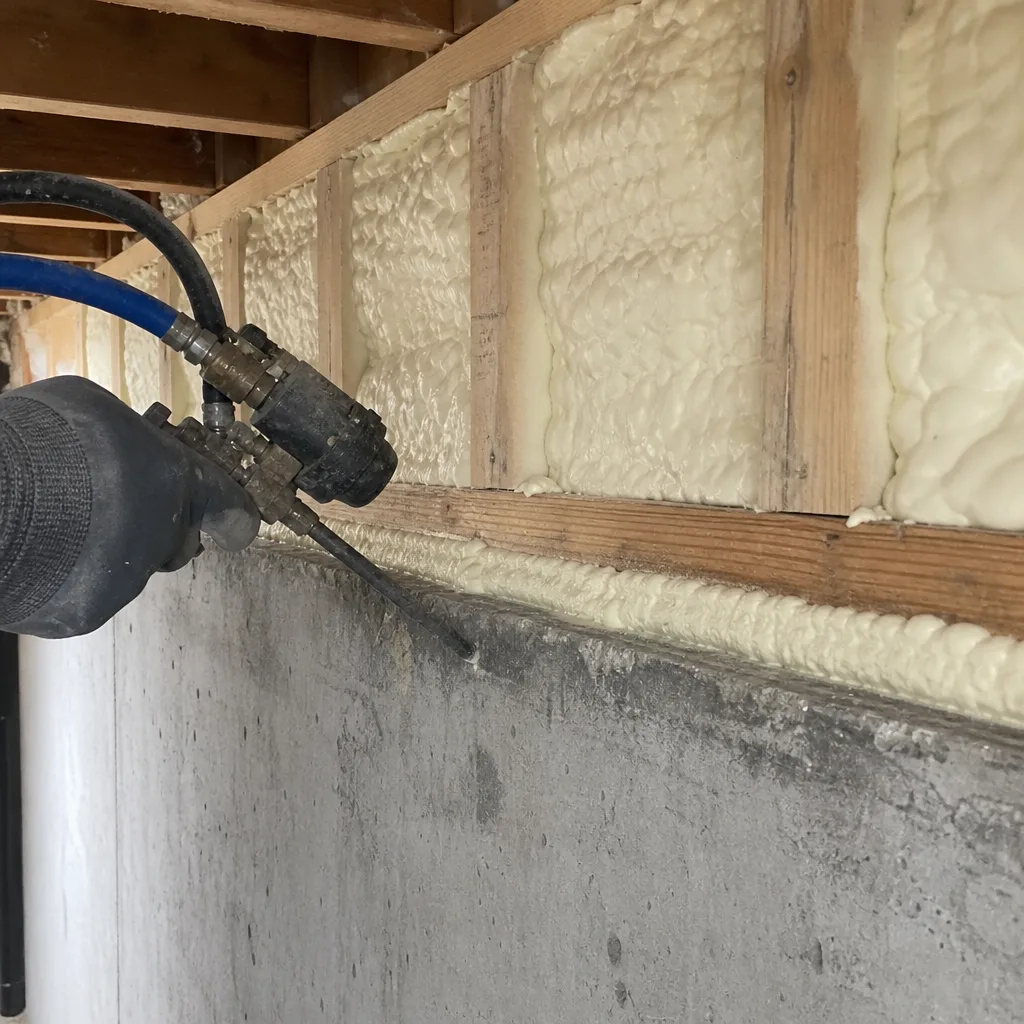
Open-cell Icynene goes against the underside of the roof deck to create a conditioned, air-sealed attic space. In Home Gardens, that’s the highest-value move for cooling season, because it stops radiant heat from beating down through the ceiling. The R-value per inch is lower than closed-cell, but its real job in this climate is air sealing, not raw thermal resistance.
For attics that still have proper venting after decades of modifications, open-cell on the attic floor is the better play. It seals the top plates and penetrations while letting the venting path keep working. On a lot where the attic is a patchwork, we choose one approach or the other based on what’s actually up there.
What an Open-Cell Job Looks Like Here
We start with the prep work that a lot of Home Gardens homes have never had done: air-sealing top plates, plumbing and electrical penetrations, and any gaps at partition walls. Then the foam goes on. Once it’s set, we go back and verify the venting path we agreed on is actually working. On older structures with ridge and soffit vents that don’t line up, that step has saved Home Gardens homeowners a lot of grief.
Spray Foam Insulation Contractors in Home Gardens
Spray Foam Insulation Contractors in Home Gardens should be telling you which foam chemistry fits your specific building, not just spraying whatever comes out of their rig. We carry two lines: Icynene and Demilec. Open-cell Icynene is our default for attic decks and interior wall cavities. Closed-cell Demilec goes on rim joists, garage ceiling edges, and any surface where water vapor, structural racking, or air infiltration is the primary enemy. Both are in active inventory.
What a typical Home Gardens engagement costs: rim joist work in a crawlspace or basement runs $800 to $1,900. Garage ceiling spray foam on a detached structure runs $1,400 to $2,800. Spray foam roof deck work, treating the attic as conditioned space, lands between $3,000 and $8,000 on the larger rural-lot homes near the 91 corridor. We give you a line-item proposal, not a one-line number.
Rim Joist and Garage Ceiling Work
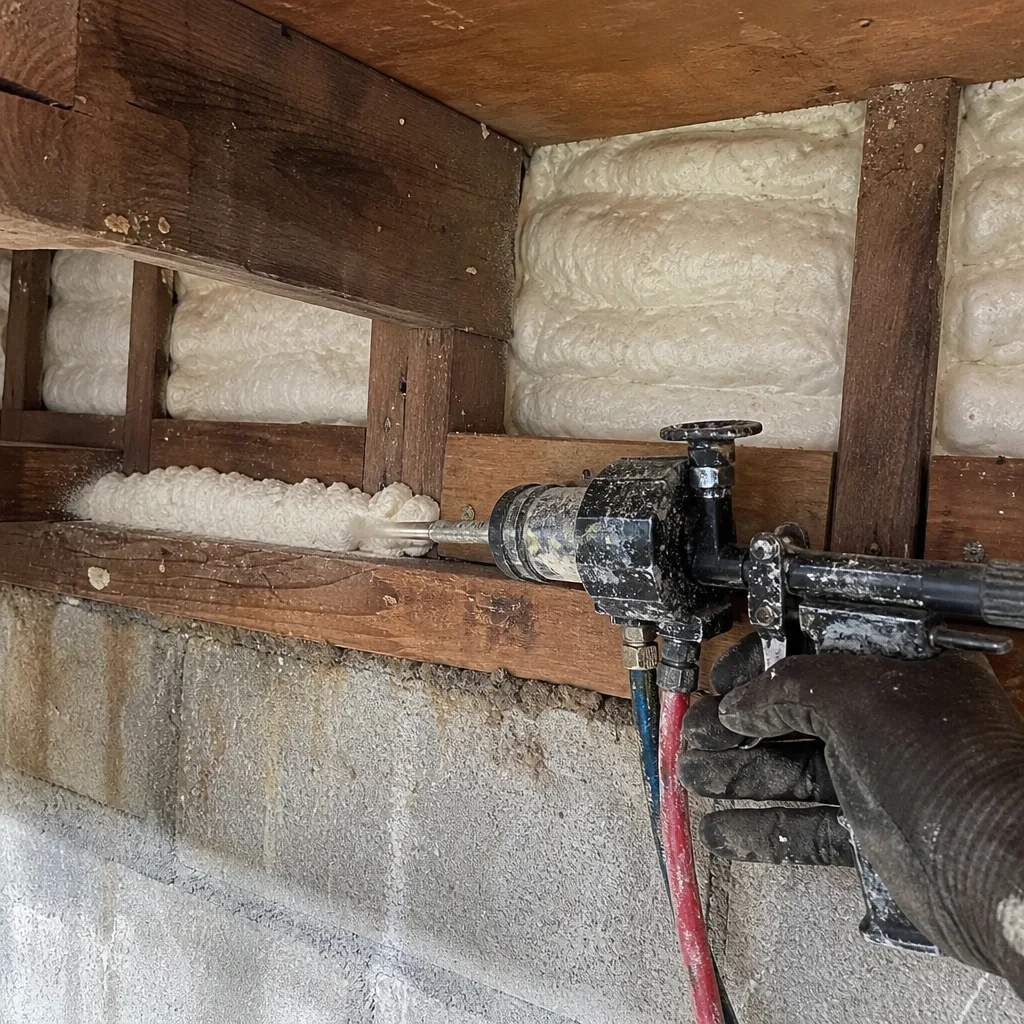
Rim joist spray foam is one of the highest-value upgrades for Home Gardens homes that sit over a crawlspace, but it’s also one of the most overlooked. An unsealed rim joist lets hot outside air pour into the floor assembly during summer. Two inches of closed-cell Demilec on the rim joist stops that loop and adds meaningful structural rigidity.
Garage ceiling spray foam matters a lot out here because so many Home Gardens properties run detached workshops and garage-turned-storage spaces with a living space above. The homeowner added a 220V subpanel, a heavier roll-up door, maybe an air compressor that runs all day. The garage ceiling becomes a heat pump into the second floor. Foam on the ceiling and the wall-to-door junction cuts that sharply.
The Right Foam for the Assembly We Actually Find
One of the most common failure modes we see on Home Gardens jobs is foam sprayed over irregular, owner-built framing without first air-sealing the top plates and any plumbing or electrical penetrations. That skips the whole point. Foam over an unsealed penetration still lets a convective loop run, and the homeowners never understand why the R-value isn’t performing. We do the prep work before the foam goes on. Every time.
Trusted Brands We Service in Home Gardens
We spec from an eight-brand material library: Owens Corning, Johns Manville, Knauf, Rockwool, CertainTeed, Icynene, Demilec, and GreenFiber. Most insulation contractors carry one or two product lines and then fit your home to those lines. We carry all eight, which means a Home Gardens homeowner with a patchwork attic, a detached workshop, and a 1960s main house gets the right product in each place. For spray foam specifically, Icynene open-cell and Demilec closed-cell cover the two chemistries. We also stock GreenFiber blown-in cellulose for homeowners who decide foam isn’t the best fit in a particular cavity. If you are hearing a bunch of promises about “the one product that does everything,” call (855) 773-6429 instead.
Common Spray Foam Insulation Problems We See in Home Gardens Homes
- Foam over unsealed framing. A Home Gardens attic that’s been added on to over 40 years almost always has open top plates and unsealed penetrations. Spraying foam over those gaps looks good on the surface but the house still leaks. We air-seal before we spray, every time.
- Dead venting paths. A lot of older Ontario Avenue homes got a new roofline and new shingles but never a venting update. Open-cell foam against the deck on an unvented, moisture-prone assembly can trap water exactly where nobody wants it. We check venting and sometimes correct it before applying foam.
- The unsealed workshop door. Detached shops with heavier roll-up doors get their walls foamed but the wall-to-door junction stays open. That junction is a major air infiltration point, and foam that ignores it still leaves the door and its opener fighting the heat. We detail that junction.
- Misjudging the permit scope. Because Home Gardens sits in an unincorporated Riverside County island, a job can straddle county and adjacent-city requirements. That means a good contractor confirms scope with the county first instead of driving over from Corona assuming. We handle that before any foam is on the truck.
Pricing for Spray Foam Insulation in Home Gardens, CA
Here’s honest money talk. An open-cell attic in Home Gardens on a standard single-family home runs $1,800 to $4,200. A large rural-lot home with a big roof deck lands between $3,000 and $8,000 for full open-cell conditioning of the attic. Closed-cell Demilec runs higher per board foot, so a rim joist job is $800 to $1,900 and a garage ceiling typically lands at $1,400 to $2,800. What moves the number: the square footage of the deck, whether your attic needs air-sealing prep first (many do here), whether venting must be corrected, and whether the structure is one continuous attic or a 1950s ranch with a 1988 addition that creates two separate assemblies. We give a written, line-item estimate before any work starts. Call (855) 773-6429 and we’ll come walk the property.
We Also Serve Cities Near Home Gardens
Home Gardens is where a lot of our patchwork-attic work lives, but we run the same crew logic in Spray Foam Insulation jobs across the surrounding Inland Empire. We serve Corona, Eastvale, Norco, and El Cerrito Corona regularly. Most of those homes were built under a single city’s building department, which makes their attics a little more predictable than what we find off Ontario Avenue. But regardless of jurisdiction, the service is the same: we match the material to the job, not the job to whatever is on the truck. You can reach us at (855) 773-6429 from anywhere in the Home Gardens area and we’ll put you on the schedule.
Serving Home Gardens, CA — Our Local Coverage Area
We’re based in the Home Gardens area and know this community well. Use the map below to see our service coverage — if you’re nearby, we can almost certainly help.
FAQs About Spray Foam Insulation in Home Gardens
Because Home Gardens is an unincorporated Riverside County island, the county is the authority having jurisdiction for most of the work. Corona does not sign off on it. For a standard attic or rim joist spray foam job, permit requirements may be minimal, but if the structure has had an addition or a roofline change, the county may want to see the scope first. We confirm jurisdiction before we quote, so you aren’t left with a surprise at inspection. Call (855) 773-6429 for your specific property.
Most of the time, yes. A detached workshop with a simple gable roof and open deck is a one-visit spray for our crew. If the structure needs air-sealing prep first, or if the venting path has to be corrected, we do the prep on the first day and spray on the second. We recently foamed the detached workshop and main attic of a 1950s ranch on Ontario Avenue in two days, including air-sealing the top plates and correcting the ridge vent path. The owner reported the shop held temperature through the afternoon sun.
Open-cell Icynene is our usual recommendation for the irregular, owner-built attics on Ontario Avenue. It expands into odd framing, gaps, and partial cavities, and it stays vapor-permeable so moisture can dry through. That’s important when the attic has no consistent venting design from decade to decade. If the attic is going to remain a vented, unconditioned space, we often switch to blown-in GreenFiber on the floor instead. We choose based on what the attic actually is, not what the truck has onboard.
It can if the venting is wrong. A lot of older Home Gardens homes had a roofline addition or a ridge vent update that was never properly connected, and spraying foam into that kind of assembly without checking the venting path can absolutely trap moisture. That’s why we inspect and often correct venting before applying foam. Open-cell Icynene stays vapor-permeable, which is another reason we lean toward it on the patchwork assemblies we see off Ontario Avenue. A properly prepped and vented attic will not “seal in” moisture.
Spray foam handles the Home Gardens summer heat better than batting, and the difference is most visible on the top floor and in rooms directly under the roof deck. Inland Riverside County summer highs sit in the high 90s and low 100s, and radiant heat through an under-insulated ceiling is the dominant comfort problem. Open-cell foam on the deck cuts the radiant transfer and seals the gaps where hot attic air pushes into the house. Batting alone, especially the R-7 patches we see on older Ontario Avenue properties, does not. For an exact assessment of your attic, call (855) 773-6429 and we’ll come look.
Written by Alan Whitcomb, Owner at Placentia Insulation, serving Home Gardens and the Inland Empire.